DocuSign's Free Plan Has 3 Limits Most People Don't See Until Doc 4
DocuSign's free plan caps senders at 3 envelopes a month, 5 recipients per envelope, and quietly locks templates, branding, and routing behind the paywall.
DocuSign's free plan caps senders at 3 envelopes a month, 5 recipients per envelope, and quietly locks templates, branding, and routing behind the paywall.
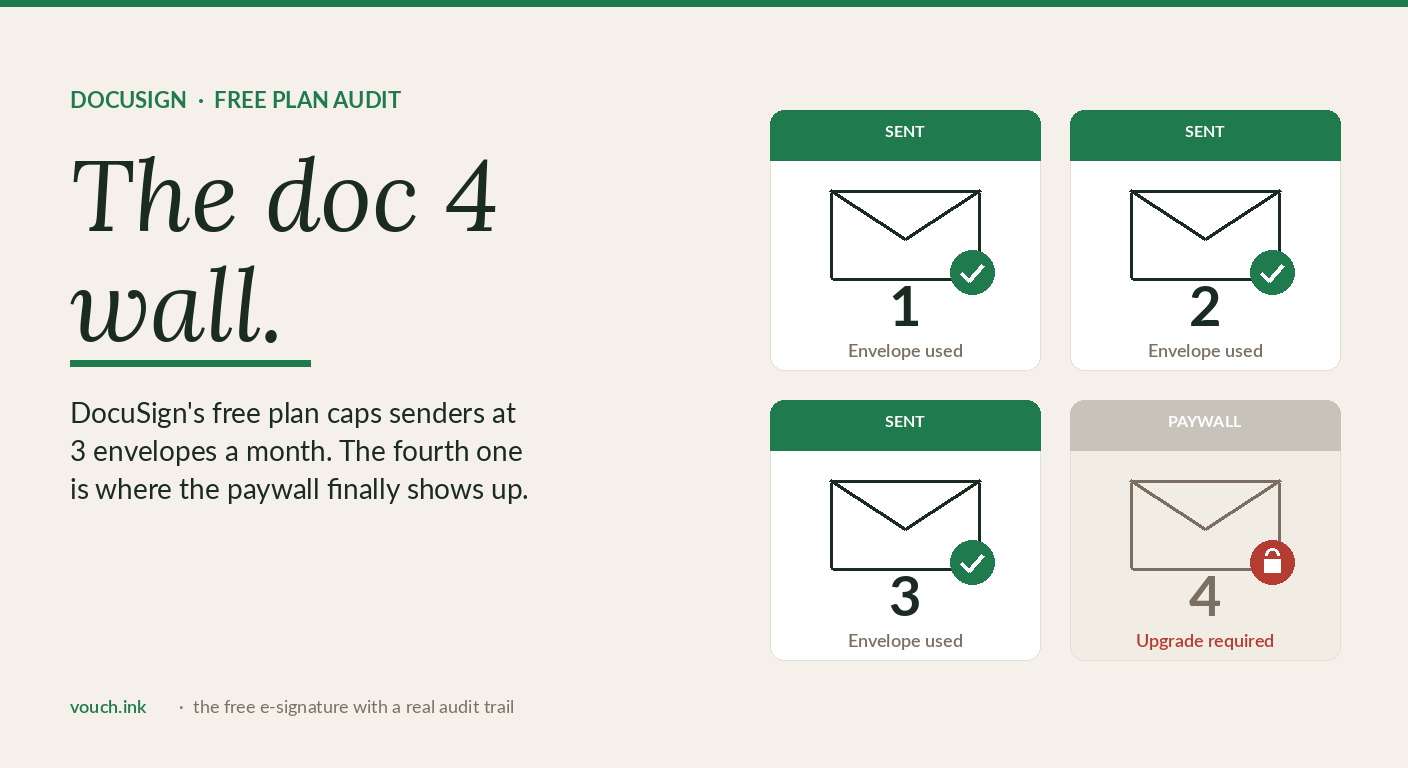
DocuSign's free plan stops working on doc 4. The cap is three envelopes per month for senders, with a separate 5-recipient ceiling on each one and a quiet wall around templates, branding, and routing. Most people don't read those limits until they hit them mid-contract, mid-week, with a client waiting on the other end.
This post walks through the three free-plan limits that catch people, the order they show up in, and what the workable options are once you're standing at one of them.
You sign up. You send your first contract. It goes through. Second one a week later, also fine. Third one, the freelancer engagement letter you've been polishing, also sends. On the fourth, you get a paywall.
That paywall is the envelope cap. DocuSign's permanent free tier gives senders three envelopes per calendar month. An envelope can hold multiple documents and multiple signers, so technically you can pack a lot into one. But the moment you press Send on a fourth, you're upgrading or waiting for the calendar to roll.
This is the limit most people don't notice until they're staring at it. The 30-day trial obscures it: for the first month you have access to most paid features, and the experience feels generous. On day 31, the account drops to the free tier, and the next time you go to send something, you find out what "free" actually meant.
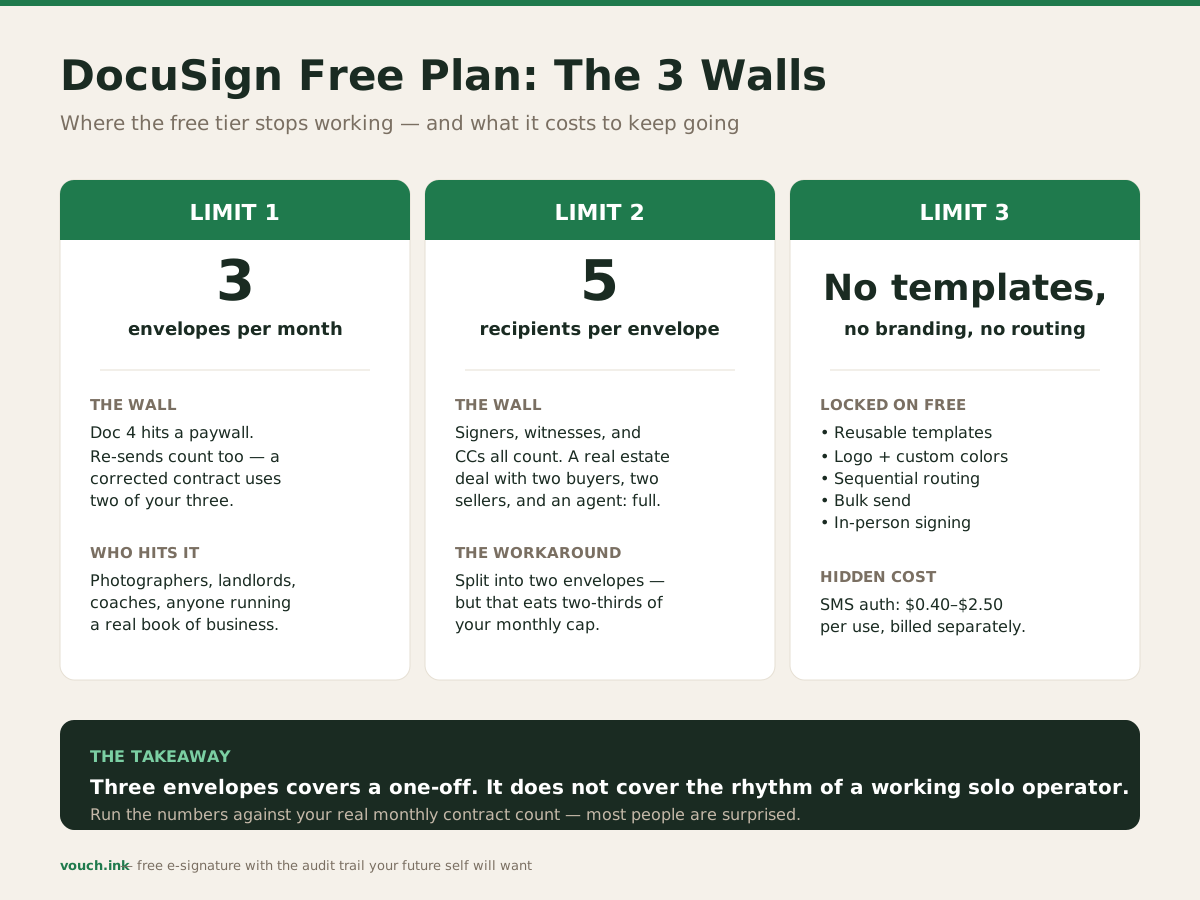
Three envelopes covers a one-off contract or two. It does not cover the rhythm of a working solo operator. A wedding photographer who books four couples in May is already short. A small landlord renewing six leases in the same window is short by half. A coach onboarding three new clients plus an NDA with a contractor sits exactly at the line, with no margin for a re-signing if a clause needs to change.
The mental math gets uglier when you account for re-sends. If a client signs the wrong field and you resend a corrected envelope, that's two envelopes against your cap for one contract. Three envelopes a month is closer to "two clean signings" in practice.
The Personal plan ($15/month at the time of writing) raises the cap to 5 envelopes/month, still a tight number for anyone running a real book of business. The next tier up unlocks meaningful volume but starts pricing the way DocuSign is best known for: per-seat, with annual commitment.
This one hides better. A "recipient" on DocuSign is anyone who interacts with the envelope: signers, CC'd parties, witnesses, in-person hosts. The free plan caps you at five.
For most contracts, five is fine. The cases where it pinches:
In every case above, you can technically split the workflow into separate envelopes. But splitting eats into your monthly envelope cap, so the 5-recipient ceiling and the 3-envelope cap compound. A contract that needed seven signatures becomes two envelopes, which is two-thirds of your monthly allowance for one job.
The first two limits are quantitative. The third is structural: the things you can't do at all on free, regardless of how many envelopes you have left.
| Feature | Free plan | Personal | Standard |
|---|---|---|---|
| Reusable templates | No | No | Yes |
| Custom branding (logo, colors) | No | No | Yes |
| Sequential signing routing | No | Limited | Yes |
| Bulk send | No | No | Yes |
| In-person signing | No | No | Yes |
| SMS authentication | Add-on ($0.40–$2.50/use) | Add-on | Add-on |
| API access | No | No | Add-on |
| Audit trail certificate | Yes | Yes | Yes |
The template lock is the one that hits operational businesses hardest. If you're a photographer sending the same wedding contract with three variables changed (date, deposit amount, package), you'd want to save it once and reuse. On free, you re-upload and re-tag every time. That's not a quota; it's a workflow tax.
Custom branding matters less for personal use, more for anyone sending contracts that should look like their business sent them, not like DocuSign sent them. The signing experience reads "DocuSign" everywhere (header, email, post-signing receipt) until you upgrade.
The SMS auth fee is the one nobody warns you about. If a contract needs an extra layer of identity verification, a one-time SMS code costs the sender per use. For domestic signers it's modest. For international, it climbs. None of this shows up on the free-plan marketing page.
A 47-unit landlord in Towson, Maryland, runs lease renewals on a 12-month rolling cycle. Average month: ~4 renewals plus the occasional change-order or addendum. Add tenant correspondence that occasionally needs e-signature (a pet addendum, an early termination) and you're looking at roughly 5–7 envelopes a month, every month, with each lease typically having 2 tenants and a guarantor.
On DocuSign's free plan, that landlord runs out of envelopes by mid-month. On the Personal plan ($15/month, 5 envelopes), they're still rationing. The Standard plan ($45/user/month) covers it, but that's $540/year for what is fundamentally a small recurring task.
The same workflow on vouch.ink's $5/month Personal plan covers 20 envelopes a month, and $8/month Business is unlimited. The difference isn't ideology. It's that vouch.ink is built for solo operators and small landlords, where DocuSign's pricing is built for sales teams.
It's worth saying clearly: if you sign one contract every quarter, the DocuSign free plan is fine. Use it. The tool is solid, the audit trail is real, and three envelopes is more than you need.
The plan starts breaking when:
If any of those describe you, you're going to hit the wall. The question is whether you'd rather hit it today and decide deliberately, or hit it on a Friday afternoon with a client waiting.
vouch.ink was built specifically for the workflow DocuSign's free plan doesn't support: solo operators and small businesses sending real volume on small budgets. The free tier is 5 envelopes/month with up to 5 signers each and the full audit trail. Personal is $5/month for 20 envelopes a month, and Business is $8/month for unlimited, both with the same hash-chained audit trail.
We've written a side-by-side comparison of DocuSign vs vouch.ink with the full feature matrix, and our pricing page lays out the caps in plain English. No "starting at" language, no enterprise-tier upsells.
If you've already been burned by doc 4 on DocuSign, the migration is short: same envelope concept, same audit trail format, same legal weight under the federal ESIGN Act. The difference shows up on doc 6, doc 12, doc 47.
Send your next contract without the cap. Free, no credit card, real audit trail.
Three envelopes per month, total. An envelope can contain multiple documents and multiple signers, but each one you send out for signature counts against the cap. On envelope four, the only path forward is upgrading to a paid plan.
Both, in different shapes. The 30-day trial gives you most paid features for a month. The actual free plan is permanent but capped at 3 envelopes/month with no templates, no branding, and a 5-recipient ceiling. Many people confuse the trial for the free plan and are surprised when limits kick in on day 31.
Five. The free plan and the 30-day trial both cap recipients at 5 per envelope. If you have a contract that needs both spouses, two business partners, and a witness, you're already at the ceiling. One more signer forces a workaround or an upgrade.
The plan itself is free, but features adjacent to signing aren't. SMS authentication runs about $0.40–$2.50 per use depending on country, and is the most common surprise. Templates, custom branding, and conditional routing aren't billed as add-ons. They're simply unavailable until you upgrade.
If you need a real free tier as a sender (not just as a signer), look for tools that publish their free-plan caps clearly. vouch.ink's free plan, for example, is 5 envelopes/month with no recipient cap, full templates, and the same audit trail the paid plan ships.