ESIGN vs. UETA: What the Two Laws Actually Cover (and Where They Overlap)
ESIGN is federal. UETA is state. Both make e-signatures binding. Here's the 95% they share, the 5% that diverges, and what it means for your next contract.
ESIGN is federal. UETA is state. Both make e-signatures binding. Here's the 95% they share, the 5% that diverges, and what it means for your next contract.
ESIGN is federal. UETA is state. Both make electronic signatures legally binding. They overlap on roughly 95% of what matters, and the remaining 5% only surfaces in specific edge cases. The short version: pick a tool that respects both, capture an audit trail, and you're covered in 49 states. New York runs its own equivalent. Here's what each law actually does and where they diverge.
The Electronic Signatures in Global and National Commerce Act passed in 2000. It says electronic signatures and electronic records have the same legal effect as paper equivalents in interstate and foreign commerce. Congress put the federal floor there so a contract signed in Maryland for a project in Ohio doesn't get thrown out because some court decides only ink counts.
ESIGN has specific carve-outs. Wills, codicils, and testamentary trusts are out. Court orders are out. Family-law documents like adoption and divorce papers are out. So are notices of utility cancellation, foreclosure, eviction, repossession, health insurance termination, and product recalls. For the everyday contract — NDA, lease, photographer agreement, contractor agreement, engagement letter — ESIGN applies cleanly.
The act also requires consumer consent for electronic delivery of legally required disclosures. If a business is going to send a consumer a mandated disclosure electronically, the consumer has to agree to receive it that way and demonstrate they can actually access it. That requirement is what generates the "ESIGN consent disclosure" you sometimes see at the start of a signing flow.
The Uniform Electronic Transactions Act is a model law drafted by the Uniform Law Commission in 1999. It's not federal. Each state adopts its own version. Forty-nine states have. New York is the holdout, and instead has the Electronic Signatures and Records Act (ESRA), which covers the same ground with different statutory language.
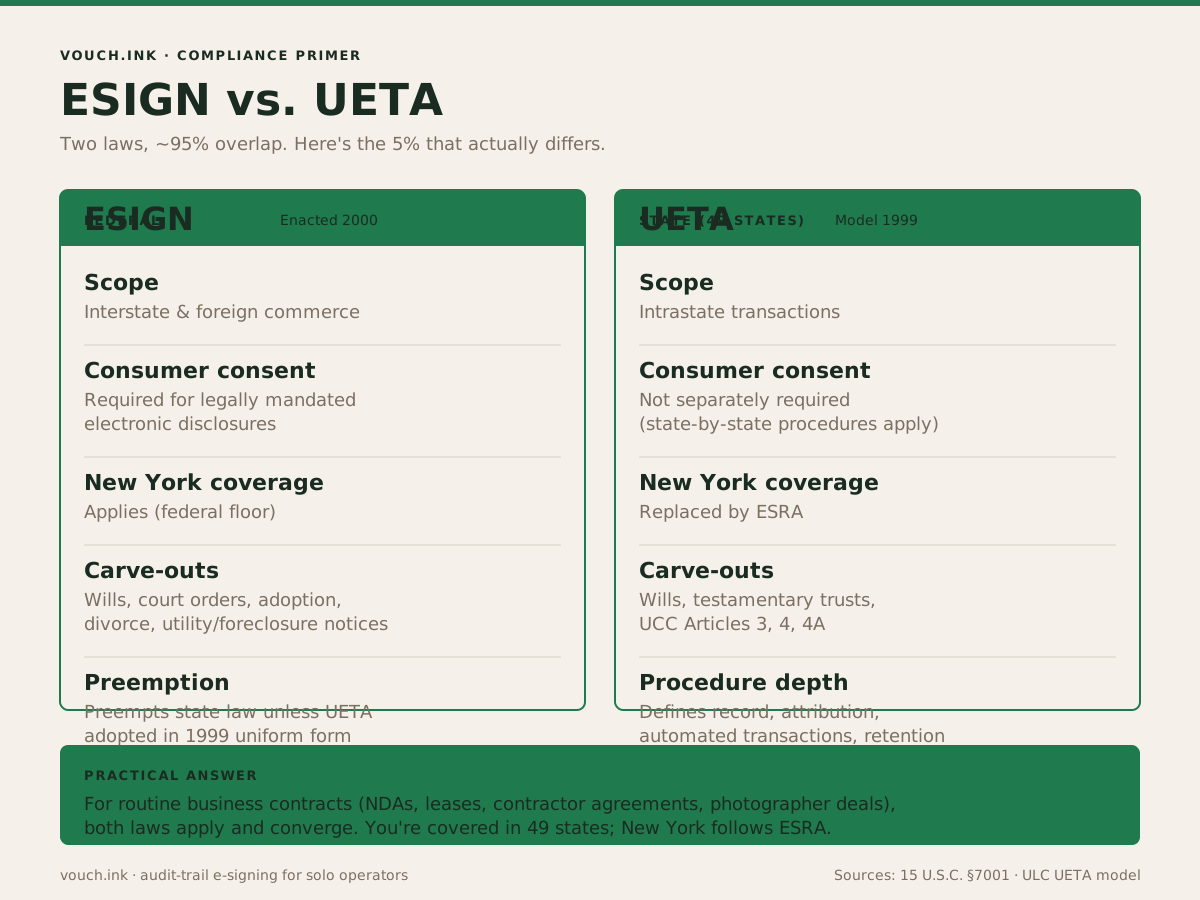
UETA goes deeper into procedure than ESIGN does. It defines what an "electronic record" is, what counts as attribution (proving the signer is who they say they are), what happens when an automated system signs on someone's behalf, and how an electronic record satisfies a legal requirement to keep an original. For day-to-day commercial signing, UETA is the law you're actually operating under.
UETA's exclusions track ESIGN's. Wills and testamentary trusts are out. The Uniform Commercial Code's Articles 3, 4, and 4A (negotiable instruments and bank deposits) are out. State-specific carve-outs vary slightly. Your state's adopted version is what governs.
Most of the time you don't pick one. Both apply. ESIGN sets the federal baseline; UETA fills in state-level mechanics. The places they actually diverge:
| Issue | ESIGN | UETA |
|---|---|---|
| Scope | Interstate / foreign commerce | Intrastate transactions |
| Year enacted | 2000 | 1999 model; state adoptions vary |
| Consumer consent disclosure | Required for mandated disclosures | Not separately required |
| Coverage in New York | Applies | Replaced by ESRA |
| Automated transactions | Recognized | Recognized + procedurally defined |
| Record retention | Records must be reproducible | Records must be accurate + retrievable |
| Specific carve-outs | Listed in federal §103 | Listed in each state's Article 3 |
ESIGN preempts state law unless the state has adopted UETA in its 1999 uniform form. Forty-seven states adopted UETA cleanly. Two states adopted UETA with non-uniform amendments, so ESIGN may still preempt in narrow situations. New York gets its own statute. In practice, almost every routine business contract is covered by both laws, and the legal posture is identical.
A 47-unit landlord in Towson signs a $1,750 lease with a tenant who lives in Pennsylvania, while the tenant fills it out from a coffee shop in Philadelphia. Three jurisdictions touch this contract: Maryland (the property), Pennsylvania (the signer), and federal commerce law (the interstate element).
The lease is enforceable because:
All three converge on the same outcome. The lease is binding, the audit trail is admissible, and a dispute would be decided on contract law, not on whether e-signatures count. The $4,200 wedding photography deposit signed across state lines works the same way. So does the contractor agreement signed by a sub in another state. The two laws are belt-and-suspenders, and the practical answer is almost always "you're covered."
The first myth: "I need a wet signature for it to count." For routine commercial contracts, you don't. ESIGN and UETA both say an electronic signature has the same legal effect as a handwritten one. The signature itself is rarely what gets disputed. What gets disputed is intent, attribution, and tampering, and those questions are answered by the audit trail, not the ink.
The second myth: "If I'm signing across state lines, I need both parties in the same state." You don't. Interstate signing is exactly what ESIGN was designed for. A lease in Maryland with a tenant in Pennsylvania, a photo deposit signed by a couple in New Jersey for a venue in Ohio, a contractor agreement signed by a sub in Florida for a job in Texas. All enforceable. The interstate element is a feature, not a bug.
Three things, and a tool that handles them.
First, capture intent. The signer needs to take an affirmative action to sign: clicking, typing their name, drawing a signature. A blank form auto-submitting isn't a signature.
Second, capture consent. Especially for consumer-facing documents, the signer should see and agree to a clear ESIGN consent disclosure before signing.
Third, capture an audit trail. Timestamps, IP, user agent, and ideally a hash chain so tampering is detectable. The audit trail does the work in a dispute. We covered this in detail in what makes an e-signature legally binding. It's the single most important piece of compliance posture for a small operator.
For the legal text itself, the official ESIGN Act on govinfo.gov is the federal source. Your state's adopted UETA lives on your state legislature's site under "Uniform Electronic Transactions Act."
vouch.ink captures intent, consent, and a hash-chained audit trail on every signature, by default, with no upgrade tier. We built it for solo operators who can't afford a compliance team. See our compliance page for the full evidence package, or start a free signing session and send your first contract in under two minutes.
ESIGN is the federal Electronic Signatures in Global and National Commerce Act, passed in 2000. UETA is the Uniform Electronic Transactions Act, a model state law adopted by 49 states. ESIGN sets the federal floor for interstate commerce; UETA fills in the state-level procedural mechanics. They overlap on roughly 95% of issues.
Only New York. New York instead has its own Electronic Signatures and Records Act (ESRA), which covers the same ground with different statutory language. The other 49 states have adopted some version of UETA.
Sometimes. ESIGN preempts inconsistent state law, but it explicitly defers to UETA where a state has adopted the 1999 uniform version. In states with non-uniform UETA amendments, ESIGN may still preempt in narrow situations. For the everyday business contract, both laws apply and converge on the same outcome.
Both. ESIGN covers the interstate element under federal commerce authority. Each signer's state UETA applies to that signer's side of the transaction. The contract is enforceable under all three layers, and the audit trail captured at signing is admissible in any of them.
Yes. Both laws exclude wills, codicils, and testamentary trusts. ESIGN also excludes court orders, adoption and divorce papers, and certain consumer notices like utility cutoff and foreclosure. UETA excludes UCC Articles 3, 4, and 4A (negotiable instruments and bank deposits). Routine commercial contracts — NDAs, leases, contractor agreements, engagement letters — are covered.