NDA Template: Free, E-Signable, and Mutually Fair (Key Clauses You Shouldn't Skip)
A free, customizable NDA template covering the five clauses that actually matter — plus how to send and store it with a timestamped audit trail.
A free, customizable NDA template covering the five clauses that actually matter — plus how to send and store it with a timestamped audit trail.
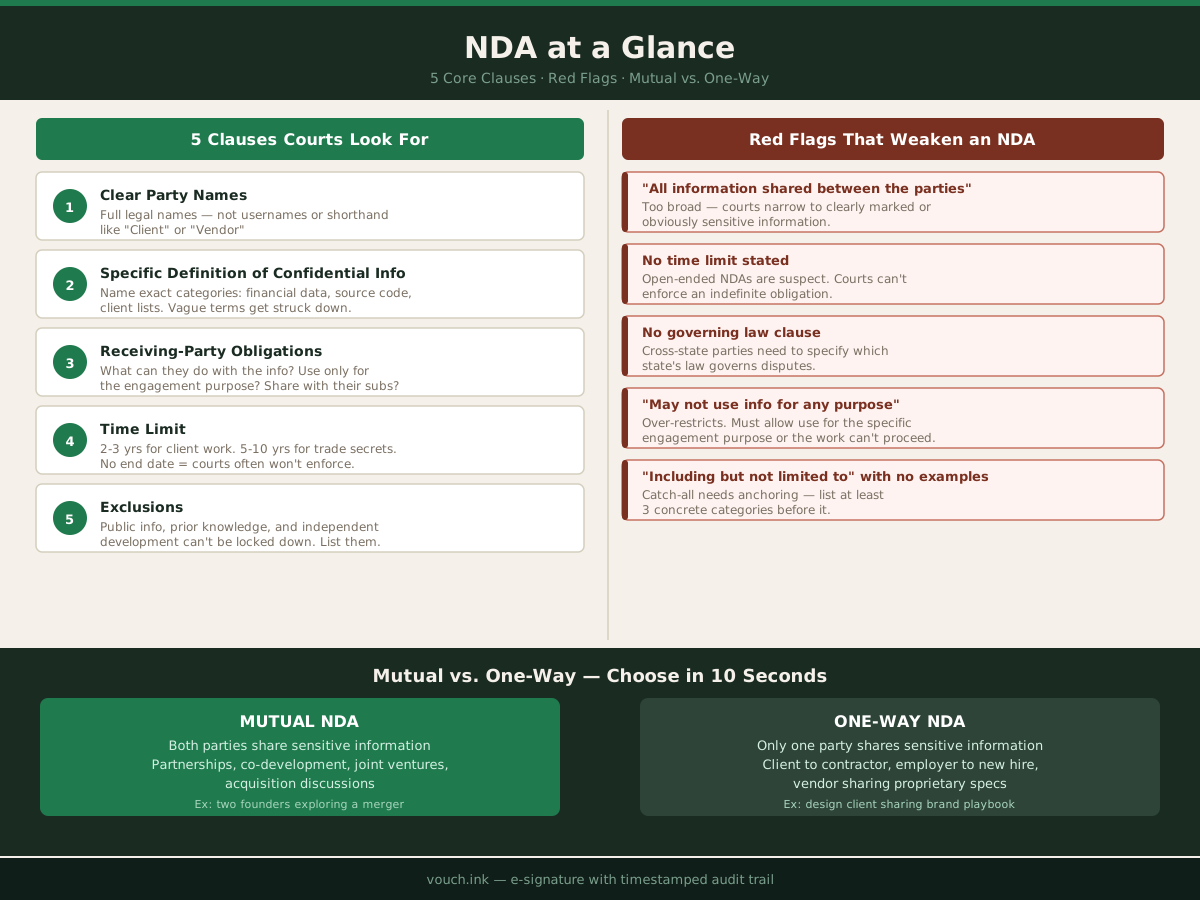
A free NDA template ready for e-signature has five core sections: party names, a specific definition of confidential information, receiving-party obligations, a time limit, and exclusions. Fill in the bracketed fields below, then send it for e-signature — start to signed in under five minutes.
An NDA — non-disclosure agreement — is a contract where one or both parties promise not to share specified information outside the relationship. It doesn't prevent someone from working in the same industry, competing with you, or disclosing that a working relationship existed. It protects specific confidential content from becoming public or being handed to a competitor.
Courts evaluate NDA enforceability on five criteria. Those five criteria are exactly why the template below is built around them. Miss one section and the whole agreement can be narrowed or rendered unenforceable — not because the template was bad, but because the missing element left a gap an attorney could walk through.
One common misconception: an NDA from a free template is not inherently weaker than one drafted by a law firm. Courts don't ask where the document came from — they read what it says. A well-customized template with specific clause language will outperform a vague bespoke agreement. The bracketed fields below are doing the real legal work; fill them in carefully.
Copy this, fill in the bracketed fields, and you have a working agreement. Don't remove any section — each one addresses a specific enforceability question.
NON-DISCLOSURE AGREEMENT

This Agreement is entered into as of [DATE] by and between
[DISCLOSING PARTY FULL LEGAL NAME] ("Disclosing Party") and
[RECEIVING PARTY FULL LEGAL NAME] ("Receiving Party").

1. CONFIDENTIAL INFORMATION
"Confidential Information" means any non-public information that
Disclosing Party designates as confidential or that reasonably
should be understood to be confidential given the nature of the
information and circumstances of disclosure — including but not
limited to: [SPECIFY: e.g., financial projections, client lists,
product roadmaps, source code, marketing strategies].

2. OBLIGATIONS
Receiving Party agrees to: (a) hold Confidential Information in
strict confidence; (b) not disclose it to any third party without
prior written consent; (c) use it solely for [PURPOSE — e.g.,
evaluating a potential business partnership / performing services
under the Agreement dated X].

3. EXCLUSIONS
This Agreement does not apply to information that: (a) is or
becomes publicly known through no breach of this Agreement;
(b) was already known to Receiving Party before disclosure;
(c) is independently developed by Receiving Party without use
of Confidential Information.

4. TERM
This Agreement is effective as of the date above and shall remain
in effect for [TERM — e.g., 2 years] from the date of last
disclosure of Confidential Information under this Agreement.

5. RETURN OR DESTRUCTION
Upon written request, Receiving Party shall promptly return or
destroy all materials containing Confidential Information and
certify destruction in writing within [e.g., 10 business days].

SIGNATURES:

Disclosing Party: _____________________  Date: ___________
Receiving Party:  _____________________  Date: ___________
| One-Way NDA | Mutual NDA | |
|---|---|---|
| Who it protects | Only the disclosing party | Both parties equally |
| When to use | Client → contractor, employer → new hire | Partnership exploration, co-development, licensing |
| Signing dynamic | One party sends, the other signs | Both parties sign simultaneously |
| Common pushback | Rarely — standard for service engagements | Contractor may object to broad mutual obligations |
Use a one-way NDA when a client is sharing a product spec, customer database, or financial model with a contractor who isn't sharing anything sensitive back. That covers roughly 80% of freelance NDA situations.
Use a mutual NDA when two businesses are exploring a partnership, joint venture, or licensing deal where both sides need to share proprietary data to evaluate the opportunity. A $1.2M SaaS licensing discussion where both teams are revealing architecture details is a mutual situation. A graphic designer receiving a brand guide to produce a campaign is not.
Once the template is filled in, the e-sign workflow takes under two minutes:
A real example: a Brooklyn-based product studio signed a mutual NDA with an enterprise prospect before sharing $340,000 worth of platform design work. The prospect went quiet. Six weeks later, a suspiciously similar design surfaced at the prospect's company. The studio's attorney pointed to the e-signed NDA's timestamped audit trail — the IP address, the signature event, the exact timestamp of when the document was opened and signed. That record compressed a potential months-long dispute into a short, productive conversation.
The template is the agreement. The audit trail is the proof. Most NDA disputes hinge not on whether one existed, but on whether the other party can credibly claim they never saw it. A PDF emailed as an attachment gives them that opening. A signed e-document with an event log doesn't.
Even a well-drafted NDA can fail on its own language:
Most of these weaknesses come from copying corporate M&A templates into a freelance or small-business context without adaptation. The template above is scoped to what a freelancer, solo consultant, or small business actually needs.
Ready to send your NDA with a timestamped audit trail? Start free at vouch.ink and have the countersigned copy in your inbox in minutes. See plans.
Yes — courts evaluate NDAs on their language, not their origin. A free template with clear party names, a specific definition of confidential information, concrete obligations, and a time limit will hold up. Vague terms like "all information discussed" tend to fail under scrutiny.
A mutual NDA protects both parties — useful when both sides are sharing sensitive information, like two startups exploring a partnership. A one-way NDA protects only the disclosing party, which is standard when a client shares proprietary details with a contractor who isn't sharing anything back.
For product development or client work, 2–3 years is standard. Trade secrets and employee agreements often run 5–10 years. Courts have struck down NDAs with no end date, so always include a specific term — even if you set it to 5 years, that's better than open-ended.
For routine freelance or contractor work, a clear standard template usually suffices. For anything involving trade secrets, software IP, or deals above roughly $50,000, a legal review is worth the investment. The template here gives you a solid starting skeleton — it doesn't replace counsel for high-stakes situations.
Yes. Under the ESIGN Act, federal law recognizes e-signatures for most contract types, including NDAs. The key is having a clear audit trail — a record of who signed, when, and from which device — so the signature can't be challenged on those grounds later.