Notary vs. E-signature: Which Do You Need?
Deciding between a notary and an e-signature depends on your document's legal requirements. This post explains when each method is necessary for document validation.
Deciding between a notary and an e-signature depends on your document's legal requirements. This post explains when each method is necessary for document validation.
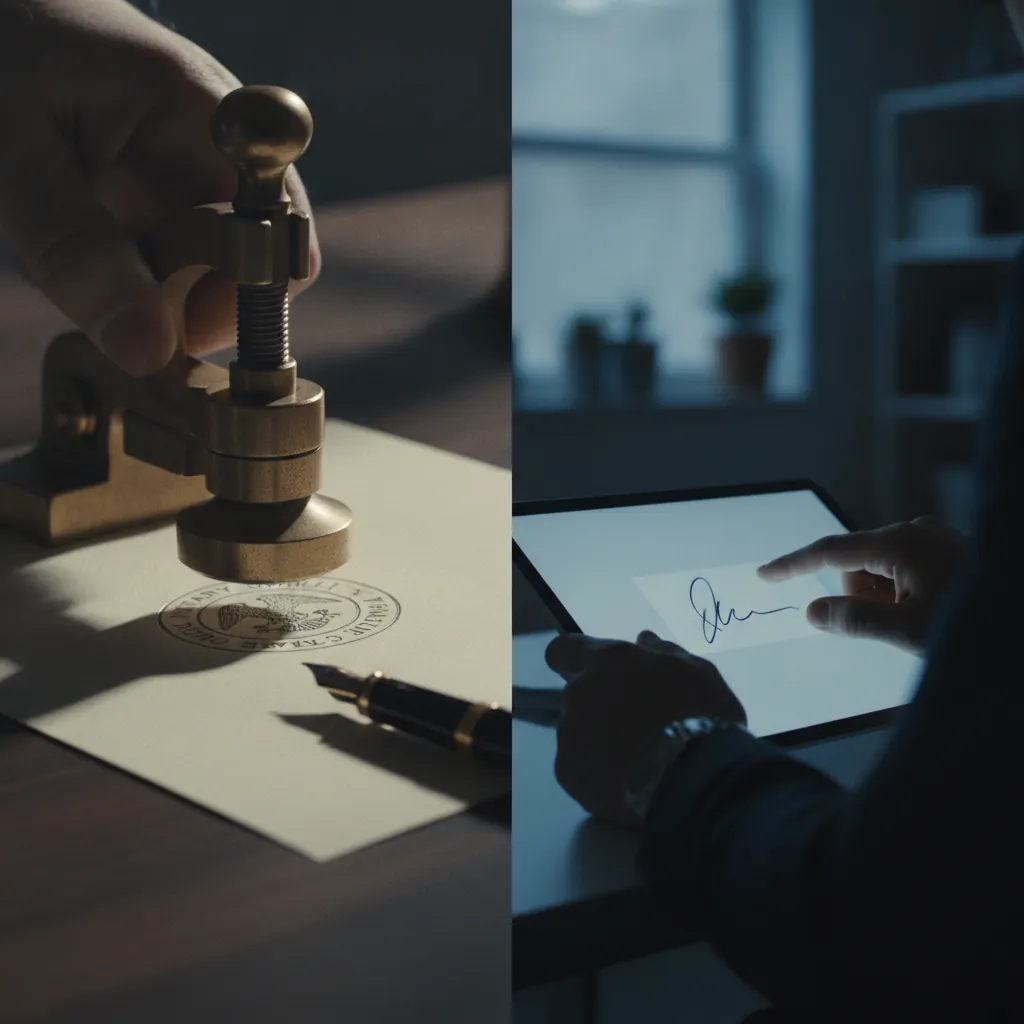
Running a small business or working as a solo operator means you wear many hats. You're the expert, the marketer, the bookkeeper, and often, the one responsible for getting documents signed. In this world, two terms often pop up: notary and e-signature. They both involve signing documents, but they serve very different purposes. Confusing them can lead to delays, legal issues, or unnecessary costs.
This post will cut through the jargon. We will explain exactly what a notary does, what an e-signature is, and, most importantly, help you figure out which one your specific business needs for different situations.
Think of a notary public as an impartial witness. Their main job is to deter fraud. When you get a document notarized, the notary verifies your identity, makes sure you are signing willingly, and confirms you understand what you are signing. They then apply their official seal and signature, which makes the document more credible in legal proceedings.
Notarization is a legal requirement for certain types of documents. These are typically high-stakes agreements where the government or courts demand extra verification to prevent fraud or coercion. Common examples include:
The process usually involves an in-person meeting. You present a valid government-issued ID, sign the document in front of the notary, and the notary then completes their part. In recent years, Remote Online Notarization (RON) has become available in many states, allowing some notarizations to happen via secure video conference. Even with RON, the core principles of identity verification and witnessing remain. If your document falls into one of these categories, or if a specific agency or party explicitly requests notarization, you will need a notary public.
An e-signature, or electronic signature, is simply a legal way to sign documents digitally. It is a symbol or process attached to a contract or other record and executed or adopted by a person with the intent to sign. The critical part here is "intent to sign."
The legality of e-signatures is well-established in the United States by two main laws:
These laws mean that for most commercial, business, and personal transactions, an e-signature holds the same legal weight as a handwritten signature.
Vouch.ink offers free e-signature software that helps you meet these legal requirements. Our system creates a hash-chained audit trail for every document. This audit trail is like a digital fingerprint, recording who signed, when they signed, and any changes made to the document. This clear, verifiable record helps prove the authenticity and integrity of your e-signed documents, making them ESIGN/UETA compliant.
Common documents signed with e-signatures include:
For solo operators and small teams, time is money and efficiency is king. E-signatures offer significant advantages that directly impact your workflow and bottom line.
Consider a photographer sending out a booking contract. Instead of printing, signing, scanning, and emailing, or even worse, mailing the document, an e-signature lets your client sign from their phone or computer in minutes. This speeds up the booking process, reduces the chance of lost paperwork, and frees you up to focus on your craft.
For a contractor, getting a change order signed quickly can prevent project delays. A landlord can finalize a lease agreement with a new tenant who is out of town. A freelancer can get an NDA signed before sharing project details. These are all real-world scenarios where the speed and convenience of e-signatures are incredibly beneficial.
If your document does not legally require a notary, and you want to streamline your operations, reduce friction for your clients, and save time, an e-signature is almost certainly the right choice.
The core difference between a notary and an e-signature boils down to the type of verification they provide and the specific legal requirements they fulfill.
A notary public provides an in-person, identity-verified attestation. They confirm:
An e-signature, on the other hand, provides digital intent and record-keeping. It legally binds a person to a document by capturing their consent electronically. While it doesn't involve a live, impartial witness physically verifying identity in the same way a notary does, modern e-signature platforms, like Vouch.ink, use sophisticated methods to create a legally binding record. This includes:
So, while both are legally valid methods of signing documents, an e-signature is not a substitute for a notary when notarization is explicitly required by law. An e-signature verifies the act of signing and the intent behind it, while a notary verifies the identity of the signer and the circumstances of the signing.
Making the right choice for your business documents comes down to a simple question: Is notarization legally required for this specific document?
For example, a contractor signing a new client agreement for a kitchen remodel will typically use an e-signature. It is fast, efficient, and legally binding. However, if that same contractor is signing a deed to purchase a new commercial property for their business, notarization will likely be required.
Always clarify the requirements with the other party or a legal professional if you are unsure. When notarization is not required, embracing e-signatures can drastically improve your operational efficiency and client experience.
For those moments when an e-signature is the right solution, Vouch.ink is built for operators like you. We understand you need tools that are straightforward, reliable, and compliant. Our platform offers free e-signature capabilities designed to meet the legal standards of the ESIGN Act and UETA.
Every document signed with Vouch.ink includes a hash-chained audit trail. This means you get an immutable, verifiable record of every signature, providing clear evidence of who signed what and when. This audit trail is your proof, giving you peace of mind that your agreements are legally sound. You do not need to worry about complex legal jargon; we handle the technical compliance so you can focus on your business.
Whether you are sending out 5 contracts a month or 50, Vouch.ink provides a simple, effective solution that integrates easily into your existing workflows. Our goal is to make getting documents signed as painless as possible, so you can close deals faster and keep your projects moving.
Knowing when to use a notary versus an e-signature is a skill every small business owner and solo operator should have. For the majority of your daily business agreements, e-signatures offer speed, efficiency, and full legal compliance. When a notary is legally required, you seek one out. For everything else, there is a better way to sign.
Ready to streamline your document signing process? See how easy it is to get started with compliant e-signatures for your business. Visit https://vouch.ink/ to sign up for free today. For details on our different plans, including our generous free offering, check out https://vouch.ink/pricing.
Q? How many different types of documents typically require notarization? A: While specific requirements vary by state and situation, roughly 5-10 common document types frequently mandate notarization, such as deeds, affidavits, and powers of attorney.
Q? How many U.S. States have adopted the Uniform Electronic Transactions Act (UETA)? A: The Uniform Electronic Transactions Act (UETA) has been adopted by 49 U.S. States, the District of Columbia, and the U.S. Virgin Islands, making e-signatures legally valid across most of the country.
Q? On average, how much faster can a document be signed using an e-signature compared to traditional paper methods? A: Documents can often be signed and returned using an e-signature in minutes or hours, compared to 2-5 days or more for traditional print, sign, scan, or mail methods.
Q? How many federal laws govern the legality of e-signatures in the United States? A: The primary federal law governing the legality of e-signatures in the U.S. Is the ESIGN Act, passed in 2000. So, 1 major federal law sets the standard.
A traditional notary is typically required for documents like real estate deeds, wills, and certain affidavits where state laws specifically mandate an in-person, witnessed signature and official seal. 1. These documents often carry significant legal weight and require the notary to verify the signer's identity and willingness.