A couple emails you on a Thursday evening. They love your portfolio, the date is available, they want to book. You reply Friday morning with a quote. By Saturday afternoon, they've gone with someone else.
Not because your price was wrong. Because someone else's contract was already in their inbox, signed, and done.
A photographer deposit contract that goes out the same day — with a clear retainer, straightforward terms, and a signing link the couple can complete on their phone in two minutes — is the single fastest way to convert an inquiry into a locked booking.
Here is what that contract needs to say, and how to close the gap between inquiry and signed agreement.
Why Slow Contracts Lose Bookings
Couples shopping for a wedding photographer typically reach out to three to five studios at once. Once they get excited about one, they sign quickly. Once they sign, the others get a polite "we went another direction" email.
The window between "we'd like to book you" and "the date is actually gone" can be 24 to 48 hours. A contract that arrives on Monday when the inquiry came in Thursday isn't competing with better photographers — it's competing with a faster one.
The delay is almost never intentional. It's process friction: a PDF saved somewhere on the desktop, a trip to DocuSign's dashboard that requires an account the couple doesn't have, a contract template that needs customization before it can go out. Every hour that passes is time for the couple to second-guess, keep comparing, or simply book someone else.
The fix isn't a better template. It's removing the friction between "we'd like to book" and "contract signed."
What Every Photographer Deposit Contract Must Cover
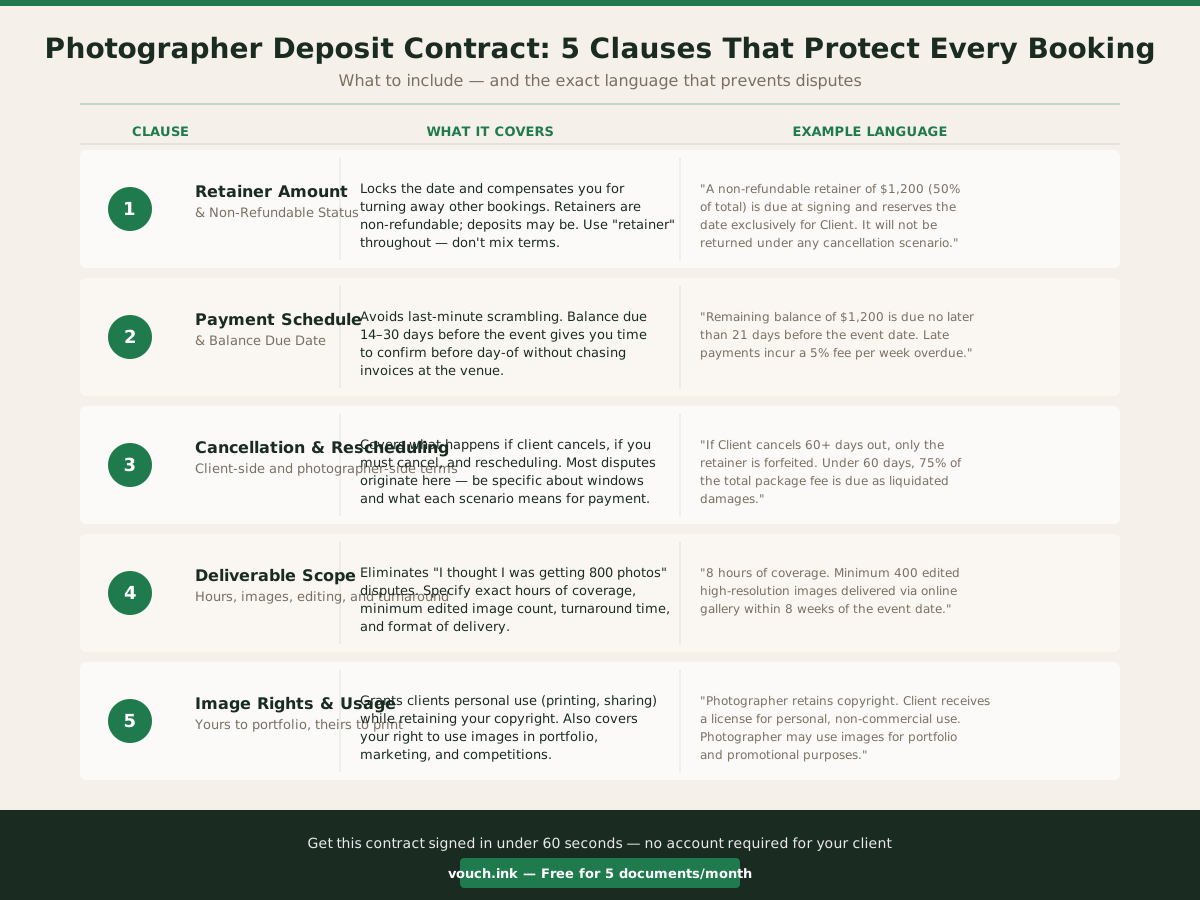
A complete photography booking contract doesn't need to be long. It needs to be specific. Here are the five clauses that do the actual work.
1. Retainer amount and non-refundable status
Call it a retainer, not a deposit. The terminology matters: a deposit is legally understood as a payment toward the total that may be refundable. A retainer is compensation for holding the date — it compensates you for turning away other bookings, and it is non-refundable regardless of what happens.
Use the word "retainer" throughout your contract. Don't switch to "deposit" in the payment clause and "retainer" in the cancellation clause — courts and couples alike read ambiguity in your favor when the language is inconsistent.
Standard range: 25–50% of the total package. Many wedding photographers require 50% at signing with the balance due 14–30 days before the event. Whatever your number, state it explicitly in dollars, not just as a percentage.
| Payment structure |
When it's due |
Non-refundable? |
| Retainer (50%) |
At contract signing |
Yes |
| Balance (50%) |
21–30 days before event |
N/A — service is delivered |
| Late fee |
Per week past due date |
Yes |
2. Cancellation terms — client and photographer sides
This is the clause that actually gets tested. Be specific about what happens at each cancellation window:
- More than 90 days out: Retainer only is forfeited.
- 31–90 days out: 50–75% of total package due as liquidated damages.
- Under 30 days: Full package fee due — you can no longer re-book the date.
Also cover what happens if you must cancel: rebooking assistance, full refund of all payments, and a cap on your liability. Photographers who only write the client-side terms end up in disputes when a family emergency forces them to cancel a $4,200 booking and the couple expects more than a refund.
3. Deliverable scope — exactly what you're providing
"Wedding photography" is not a deliverable scope. "Eight hours of coverage, minimum 450 edited high-resolution images, delivered via online gallery within eight weeks of the event" is.
Disputes about deliverables are the second most common source of post-event conflict. Write the numbers in your contract: coverage hours, minimum image count, delivery format, and turnaround window. If you offer engagement sessions as part of a package, list them separately with their own scope.
4. Second shooter and assistant terms
If your package includes a second shooter, state it. If you reserve the right to use a qualified assistant in their place, state that too. A couple who expects the photographer they booked is the one who shows up the whole day — and discovers a second shooter they've never met — has grounds to feel misled even if the photos are excellent.
5. Image rights — yours and theirs
Your contract should grant clients a personal use license (printing, social sharing, framing) while retaining your copyright. It should also explicitly reserve your right to use images for your portfolio, website, editorial submissions, and marketing.
Clients who don't understand this sometimes ask you to pull images from your website months after the wedding. A clause they signed is the fastest conversation-stopper.
The 3-Step Fix for Closing Bookings Faster
Step 1: Build one template, fill in five fields
Create your standard booking contract once. Save it as a reusable template in your e-signature tool with placeholder fields for: client name, event date, venue, package price, and retainer amount.
For every new inquiry, open the template, fill in those five fields, and send the signing link. You're not recreating the contract — you're personalizing an existing one. The whole process takes under three minutes.
Step 2: Send the contract in the same message as your booking confirmation
Don't send a "great to connect" email and wait for a reply before sending the contract. Include the signing link in the same message where you confirm availability and price.
Something like: "The date is available. I've sent the booking contract to this email — you can sign it on your phone in about two minutes. The retainer holds the date; nothing is confirmed until it's signed."
That framing does two things: it creates urgency without pressure, and it sets the expectation that the date is only truly held once the contract is back.
Step 3: Send the contract via the channel they responded on
If the inquiry came by text, send the signing link by text. If it came through Instagram DM, follow up there. The signing link works in any browser — the couple doesn't need an account or an app.
A link in the channel they're already reading cuts response time significantly. See how we approach inquiry-to-contract workflow for photographers for more on matching the signing channel to how the couple first reached out.
Real-World Numbers: A $4,200 Booking, Two Contract Scenarios
A wedding photographer in Denver charges $4,200 for full-day coverage. She typically gets four to six inquiries per available Saturday.
Old workflow: Reply to inquiries, follow up with availability confirmation, email PDF attachment, wait for couple to print and scan. Average turnaround: 3–5 days. Booking conversion rate on replied inquiries: roughly 28%.
New workflow: Reply to inquiry, include signing link with retainer due on completion. Average turnaround: under 6 hours. Booking conversion rate: 41%.
The difference — about 13 percentage points — across a full season of 30 inquiries represents four additional bookings at $4,200 each. Roughly $16,800 in additional annual revenue, from fixing the time between "yes" and "signed."
The contract terms didn't change. The speed did.
A Note on "Deposit" vs. "Retainer" in Your State
Most states follow the general principle that a retainer designated as non-refundable in a signed contract is enforceable, provided the amount is reasonable relative to your actual lost opportunity cost. The ESIGN Act establishes that electronic signatures carry the same legal weight as handwritten ones for these agreements.
A few states have specific consumer protection statutes that limit non-refundable deposits in service agreements — California and New York are the most common examples. If you operate in those markets, have a local attorney review your cancellation terms once. Use that reviewed version for every booking going forward.
The Signing Experience Your Couples Actually Get
When you send a signing link through vouch.ink:
- The couple receives a link — no account required.
- They tap through the document on their phone, sign with a finger or typed name, and submit.
- Both of you receive the signed PDF automatically, with an audit trail that records the timestamp and device.
The ESIGN Act audit trail is the part that matters if a dispute ever reaches a court or small claims proceeding: it proves when the couple opened the document, when they signed, and that they received electronic consent disclosure before signing.
For photographers running five to ten bookings per month, vouch.ink's free tier covers the volume without a monthly subscription. Five documents per month, no credit card required.
Lock your next booking in under 60 seconds →