Signature Certificates of Completion: What They Mean
A signature certificate of completion confirms a project or task is finished and accepted. It serves as formal documentation of work delivered.
A signature certificate of completion confirms a project or task is finished and accepted. It serves as formal documentation of work delivered.
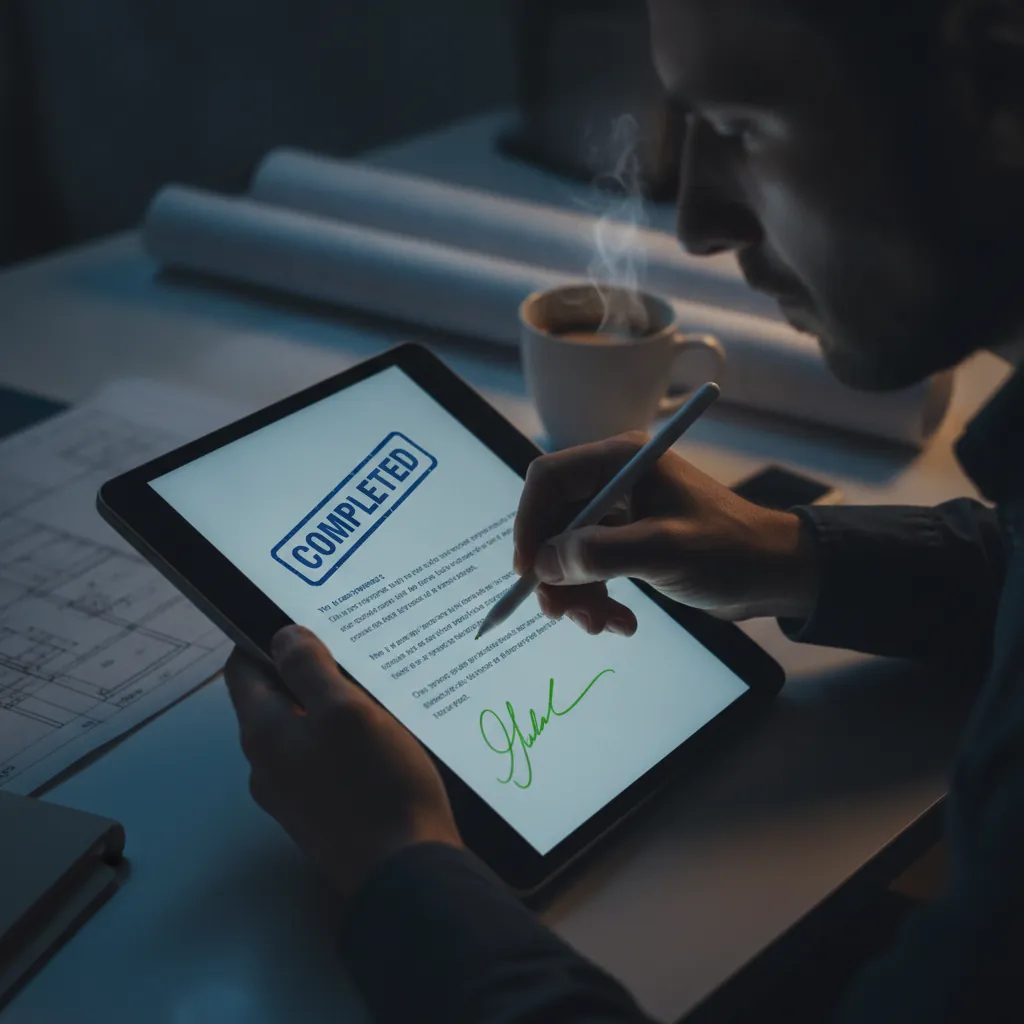
Finishing a project feels good. You’ve put in the hours, delivered the service, or built the thing. The client is happy, you’re ready to move on, and most importantly, you’re ready to get paid. But what happens if, weeks or months down the line, there’s a disagreement? Maybe the client "forgets" some of the work you did, or claims something wasn't quite finished. A simple handshake won't hold up. This is where a signature certificate of completion steps in, acting as your official proof of work done and accepted.
For solo operators, small agencies, contractors, photographers, landlords, or any freelancer, formalizing the end of a project isn't just good practice. It's a shield for your business and a clear path to getting paid without fuss. It’s a document that says, plainly and officially, "This work is finished, and everyone agrees."
Think of a certificate of completion as the final stamp on your project. It's a formal document, signed by all involved parties, that confirms a specific task, service, or project has been finished according to the agreed-upon terms and standards. It’s not just a receipt. It’s a mutual declaration that the work is complete, delivered, and accepted.
For a contractor renovating a kitchen, it confirms the cabinets are installed, the plumbing works, and the paint is dry. For a photographer, it means the final edited photos have been delivered and approved. For a landlord, it might signify that a repair job is done and the tenant is satisfied. This document closes the loop, providing a clear record for both you and your client. It puts an end to any ambiguity about when the work ended and what was delivered.
It doesn't have to be a complicated legal form. It just needs to clearly state what was completed, when it was completed, and by whom. The signatures are what give it weight, turning a simple statement into a legally recognized agreement.
As a solo operator or a small business, your time is money. You want to focus on doing good work, not on chasing down payments or debating past projects. A certificate of completion takes away much of that potential headache. It's a proactive step that protects your interests and streamlines your business operations.
First, it’s undeniable proof. You can point to a signed document that says, "Yes, the work was finished on this date, and you agreed it was complete." This can be invaluable if a client later claims the work was incomplete or unsatisfactory. Without it, you might find yourself in a "he said, she said" situation, which is costly and stressful to resolve.
Second, it provides clarity for everyone. Both you and your client know exactly when the project is considered done. This prevents scope creep after the fact and sets clear expectations for final payment. For example, a web designer delivering a new site can use it to confirm all agreed-upon pages and functionalities are live. A consultant finishing a project report can confirm the report has been submitted and accepted.
Finally, it often acts as a trigger for final payment. Many contracts specify that the final invoice is due upon completion and acceptance of work. A signed certificate of completion provides that formal acceptance, making it harder for clients to delay payment without a valid reason. It shifts the burden of proof, putting you in a stronger position to collect what you’re owed.
Disputes happen. Even with the best intentions, misunderstandings can arise, or clients might forget details over time. This is where a signed certificate of completion becomes a critical piece of your business defense. It’s not just about getting paid. It’s about protecting your reputation and avoiding costly legal battles.
Imagine you're a contractor who finished a home repair. Months later, the homeowner claims a related issue was part of your original scope and wasn't fixed. Without a certificate, it's your word against theirs. With a signed certificate, you have a document clearly stating what was completed and accepted at the time. This document provides a specific record of what was covered and what was signed off as done.
When you use an e-signature service like vouch.ink, that protection gets even stronger. Every document signed through vouch.ink comes with a hash-chained, ESIGN/UETA-compliant audit trail. This means you don't just have a signature. You have a digital record showing who signed, when they signed, their IP address, and other critical data points. This audit trail is practically tamper-proof. It provides irrefutable evidence of the signature's authenticity and the document's integrity. If a client ever tried to claim they didn't sign, or that the document was altered, your audit trail provides a strong, legally recognized defense. This compliance with ESIGN and UETA acts as a legal backbone, meaning your digital signatures hold the same legal weight as traditional wet ink signatures. It's a powerful layer of security for your business.
A certificate of completion doesn't need to be overly complex, but it does need to contain specific information to be effective. The goal is clarity and a clear record of agreement. Missing key details can weaken its purpose, so make sure you include these elements:
First, clearly identify the parties involved. List your business name and your client's name or business name. Include contact information for both. This leaves no doubt about who agreed to what.
Second, provide a detailed description of the project or services completed. Be specific. Instead of "website design," write "Development and launch of a 5-page e-commerce website, including product catalog, payment gateway integration, and contact form." For a photographer, it might be "Delivery of 150 edited wedding photographs and a 20-page album design." This specificity removes any guesswork about what was actually finished.
Third, state the official date of completion. This is the date when all work was finalized and accepted by the client. This date is important for payment terms and for establishing a timeline if any future questions arise.
Fourth, include a clear statement that the work has been completed to the satisfaction of the client and according to the agreed-upon terms of the initial contract. This is the core of the certificate. It's the client's acknowledgment that you've fulfilled your obligations.
Finally, and most importantly, spaces for signatures and dates from all parties involved. A signed certificate is what gives it legal authority. Without signatures, it's just a piece of paper. You might also include a project reference number or invoice number to link it to other project documentation.
The days of printing, signing, scanning, and emailing documents are, thankfully, largely behind us. For solo operators and small teams, efficiency is paramount. Digital certificates of completion, powered by e-signature software, save you significant time and hassle. They make the process faster, more secure, and easier to manage.
Think about the traditional method. You finish a job, create the certificate, print it, drive to the client, have them sign it, then drive back to your office to scan it and file it. Or, you email it, they print it, sign it, scan it, and email it back. This can add days to the process, especially if your client is busy or located remotely.
With a digital solution like vouch.ink, you create the document, upload it, and send it for signature with a few clicks. Your client receives an email, clicks a link, reviews the document, and signs it digitally from their computer or phone. The entire process can take minutes, not days. This speed means you get your official completion record much faster.
Beyond speed, digital certificates offer better organization and security. No more lost papers or messy filing cabinets. All your signed certificates are stored securely in the cloud, accessible whenever you need them. And as mentioned, vouch.ink provides that hash-chained audit trail, which is automatically generated with every signature. This means you have an unalterable record of the signing event, providing a level of security and legal backing that a simple paper signature often lacks. It brings your completion process into the modern age, making it simpler for everyone involved. Get started with digital signatures at https://vouch.ink/.
One of the most direct benefits of using a signature certificate of completion is its impact on your cash flow. For many small businesses and freelancers, the final payment is the biggest hurdle. A signed certificate helps you clear that hurdle quickly and cleanly.
When your contract ties final payment to project completion, having a signed certificate means you have undisputed proof that the condition for payment has been met. This leaves little room for a client to delay payment by claiming the work isn't finished or wasn't done correctly. You can attach the signed certificate directly to your final invoice, presenting a complete package that justifies the payment request.
Consider a freelance photographer. They deliver the final edited photos. The client signs the certificate of completion. That signed document then goes with the final invoice. It's a clear trigger. The client cannot reasonably argue the photos weren't delivered or accepted. This reduces the time you spend chasing down late payments, allowing you to focus on your next project and generate more income.
For a landlord, a repair certificate signed by the tenant confirms work was done and accepted, preventing future disputes about the repair's timing or quality. This clarity helps maintain good tenant relations and makes rent collection smoother. Ultimately, a certificate of completion speeds up the process from project delivery to money in your bank account. It’s a simple tool that has a big impact on your financial stability.
A signature certificate of completion isn't just another piece of paperwork. It's a strategic tool for any solo operator or small team. It provides clarity, protects your business, and helps you get paid on time. By formalizing the end of every project with a clear, signed document, especially with the added security of a digital audit trail, you build a stronger, more efficient business. Ready to streamline your project completion and payment process? Visit https://vouch.ink/ to try our free e-signature software and see how easy it is to create and sign completion certificates. For details on plans that fit your growing business, check out https://vouch.ink/pricing.
Q: How many parties typically sign a Certificate of Completion? A: Usually 2, representing your business and the client, but it can be 3 or more if there are additional stakeholders or subcontractors involved in the sign-off process.
Q: How long should I keep signed Certificates of Completion? A: Many businesses keep signed certificates for at least 7 years to align with tax regulations and potential statute of limitations for contract disputes.
Q: What percentage of payment disputes can be avoided with clear completion documents? A: Industry data suggests that up to 40% of payment disputes arise from unclear project completion criteria, which a signed certificate can effectively resolve.
Q: How quickly can I get a digital certificate signed compared to a paper one? A: Digital signing can reduce the turnaround time by over 80%, often taking minutes instead of days or weeks for remote clients.
Q: How many documents can I send for signing with vouch.ink's free plan? A: You can send 3 documents per month for free with vouch.ink, making it easy to start formalizing your project completions.
A signature certificate of completion is a formal document confirming that a project, task, or phase of work has been successfully finished and accepted by the client or relevant party. It typically includes details about the work, dates, and signatures of approval. 1
These certificates are important for several reasons. 1. They provide official proof of work delivery. 2. They can help resolve disputes by documenting agreement. 3. They often trigger final payments or project closeout procedures. 2
Vouch.ink simplifies the creation, distribution, and secure signing of completion certificates digitally. It offers a verifiable record, making the process efficient and transparent for all involved parties. 3
Yes, they can be adapted for partial project completion or specific milestones. This allows for formal acknowledgment of progress at various stages of a larger project. 4