Will My E-Signed Contract Hold Up in Court? (Honest Answer)
Yes — but only if the signature comes with an audit trail that proves who signed, when, and that nobody altered the document afterward.
Yes — but only if the signature comes with an audit trail that proves who signed, when, and that nobody altered the document afterward.

The short answer is yes. An e-signed contract can hold up in court — often more convincingly than a paper one. But whether yours specifically survives a challenge depends almost entirely on what evidence was captured at the moment of signing.
Here's what courts actually evaluate, and what you should check before you send another contract.
The federal ESIGN Act (15 U.S.C. § 7001) and the Uniform Electronic Transactions Act — adopted in 49 states and Washington D.C. — give e-signatures the same legal effect as handwritten ones. This has been settled law since 2000.
The law isn't really the question anymore. The question is: when a signer disputes your contract, what proof do you have?
When an electronic signature becomes a point of contention, judges focus on three specific things:
Identity — Was this actually the person who signed? A typed name in a blank field proves very little. An IP address, email delivery record, and device fingerprint tied to that exact signing moment prove significantly more.
Intent — Did the person mean to sign? Courts want to see the signer opened the document, scrolled through it, and deliberately clicked to complete the action — not that they were rushed or signed something they didn't meaningfully review.
Integrity — Has the document been altered since signing? This is where e-signatures become genuinely stronger than paper. A properly sealed document carries a cryptographic hash: any change to even one character breaks the hash and proves tampering.
A court isn't ruling on whether e-signatures are valid in general — that's established law. A court is ruling on whether this specific signature on this specific document was authentic at the time it was applied. That's an evidence question, not a legal-theory question.
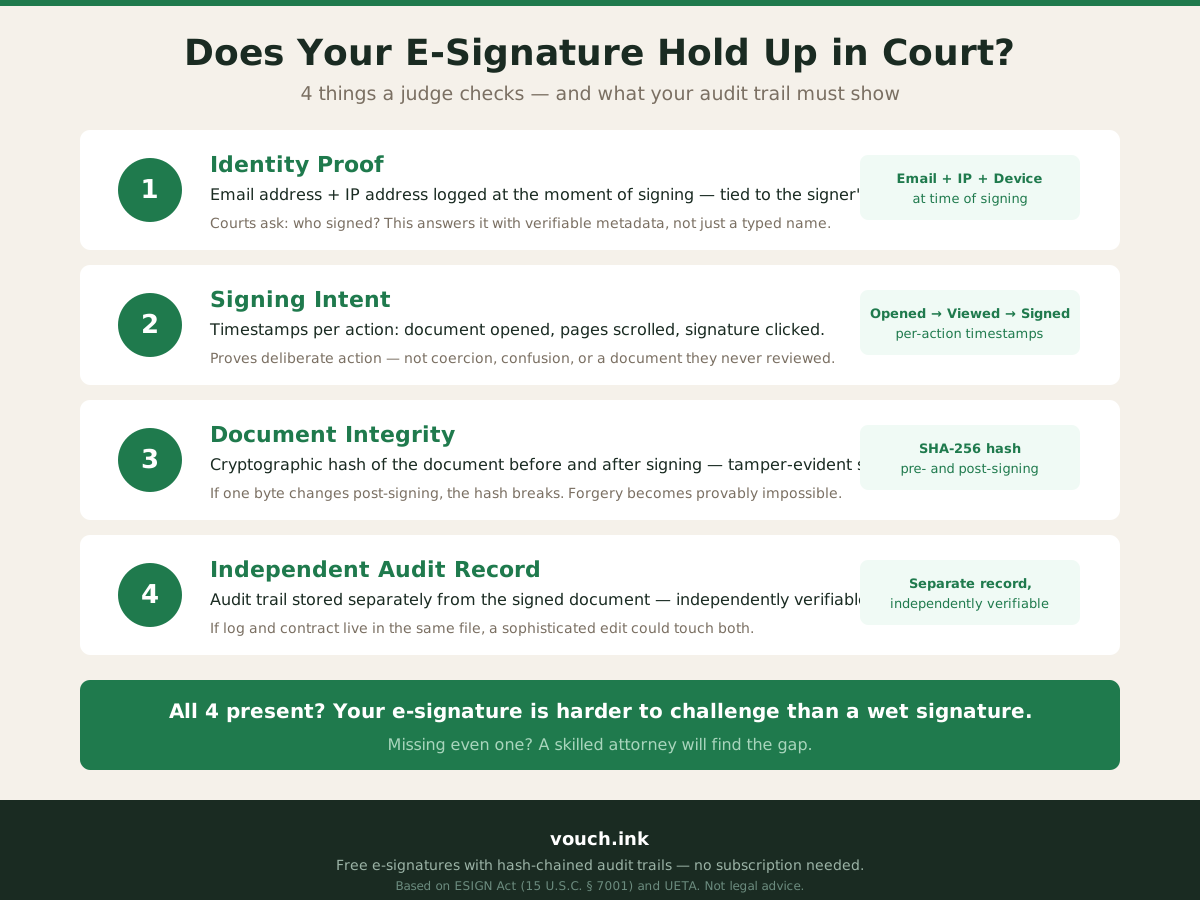
An audit trail answers all three questions above. A complete one shows:
That hash chain makes a verified e-signature provably more secure than a physical signature in many real disputes. You can scan a wet signature and paste it onto a different contract. You can't retroactively forge a hash-chained signing record — any attempt produces a hash mismatch that invalidates the entire record.
Courts have admitted audit trail exports as business records under Federal Rule of Evidence 803(6), bypassing the hearsay rule because the records were created in the ordinary course of business by a neutral system. When the chain of evidence exists before any dispute arises, authentication becomes a formality rather than a courtroom fight.
A wedding photographer in Raleigh sends a $4,200 deposit contract as a PDF attachment. The client types their name, saves the file, and emails it back. Six months later — after a cancellation — the client claims they never agreed to the no-refund clause.
The photographer has: a signed PDF. Nothing else.
The opposing attorney argues the photographer could have swapped the contract after the client signed an earlier version without that clause. Without a tamper-evident record proving exactly what document was signed and when, that argument has real legs.
Now flip it: the photographer used a platform that generates a proper audit trail. The export shows the client opened the document at 7:43 PM, scrolled to page 2 where the deposit clause appears, and clicked to sign at 7:51 PM. The document hash matches. No post-signing edits are possible without breaking the record. Case over.
Not all e-signatures carry the same evidentiary weight. Courts don't treat them equally.
Weak: A typed name in a PDF form with no associated metadata. Without supporting records, it comes down to your word against theirs.
Moderate: A click-to-sign workflow with email delivery confirmation. Better — you can show the signing email reached their inbox. But without per-action timestamps, you can't prove they viewed the critical clauses before signing.
Strong: A full audit trail — email, IP, per-action timestamps, document hash, tamper-evident seal. This is what courts have consistently upheld. The chain of evidence was created at signing, before any dispute existed, by a neutral system.
The cost difference between weak and strong is often nothing. The outcome difference in a real dispute can be thousands of dollars.
A few document types are explicitly carved out of ESIGN and UETA. E-signing these creates no legal effect:
| Document type | Why wet signature still required |
|---|---|
| Wills and testamentary trusts | State law requires witnesses and notarization |
| Court orders and evidentiary filings | Court rules govern format independently |
| Foreclosure and utility shutoff notices | Consumer protection mandates physical notice |
| Adoption and certain divorce decrees | Governed by family court procedures |
| Some real estate deeds | State-specific — many states now accept e-recorded deeds; check locally |
For everything else — freelance agreements, deposit contracts, lease renewals, service agreements, coaching contracts — you're fully covered under federal and state law.
If you're already using e-signatures, verify these now:
Does your platform generate an audit trail document? Download a test export. It should show per-action IP addresses and timestamps — not just "signed on [date]."
Is there a cryptographic hash of the signed document? The record should include a fingerprint of the final signed version. Without it, document integrity can't be independently verified in a dispute.
Is the audit trail stored separately from the contract? If the log and the document live in the same file, a sophisticated edit could potentially affect both. They need to be independent records.
For contracts involving real money — deposits, retainers, project minimums — these aren't optional checkboxes. See how vouch.ink handles audit trails and tamper-evident records, or read what an audit trail actually records for the full breakdown of each data field captured at signing.
Will your e-signed contract hold up in court? Almost certainly yes — if it came with a proper audit trail. Courts across the U.S. have consistently upheld e-signatures backed by timestamp, IP, and hash-chain evidence.
Without that evidence layer, you're relying on the other party's honesty and hoping their attorney doesn't ask the right questions.
Send every contract with audit trail documentation built in. The law is on your side. Make sure the evidence is too.
Send contracts with full audit trails — free, no subscription required →
Yes. Under the federal ESIGN Act and state UETA laws, e-signatures have the same legal effect as handwritten ones. Courts have consistently upheld e-signed contracts in disputes — especially when a verifiable audit trail accompanies the document.
Judges focus on three things: identity (who signed), intent (did they mean to sign), and document integrity (was it altered after signing). Audit trail data — IP address, timestamp, device fingerprint, email confirmation — addresses all three directly.
They can try, but a detailed audit trail makes it very difficult. Records showing the signer opened the email, viewed the document, and clicked to sign — tied to their IP and device — are strong evidence of both identity and intent.
ESIGN and UETA exclude wills and testamentary trusts, court orders, certain family law documents, and foreclosure or utility shutoff notices. Most business contracts — freelance agreements, deposits, service contracts — are fully eligible.
Technically yes, but it's weak evidence. A typed name without any supporting metadata is easy to dispute. A signature backed by an email audit trail, IP log, and tamper-evident hash is orders of magnitude harder to challenge.