Hash-Chained Audit Trails: What That Phrase Actually Means
Hash-chaining links every signing event to the one before it with a cryptographic fingerprint — making any tampering with your audit trail mathematically detectable.
Hash-chaining links every signing event to the one before it with a cryptographic fingerprint — making any tampering with your audit trail mathematically detectable.

A hash-chained audit trail links every signing event to the one before it using a cryptographic fingerprint. Change any event — even a single timestamp — and every entry that follows it breaks. That's not a feature of your e-signature platform's marketing. That's math.
If the phrase sounds like blockchain buzzword soup, keep reading. This is simpler than it sounds and worth understanding if you ever need your signed contracts to hold up in a dispute.
A hash function takes any input — a document, a sentence, a timestamp — and produces a fixed-length fingerprint called a hash. SHA-256 (used in most commercial e-signature systems) always produces a 64-character string.
Three properties make it useful:
A concrete example: the string Contract signed by Maria Lopez at 2026-04-14 09:32:01 UTC produces a specific 64-character hash. Change 09:32:01 to 09:32:02 — one digit — and the output is completely different. There's no mathematical relationship between the two hashes.
That's what tamper evidence means in practice. A hash stored at signing time is a commitment: if the data and the stored hash still match later, the data hasn't been touched. If they don't match, something changed.
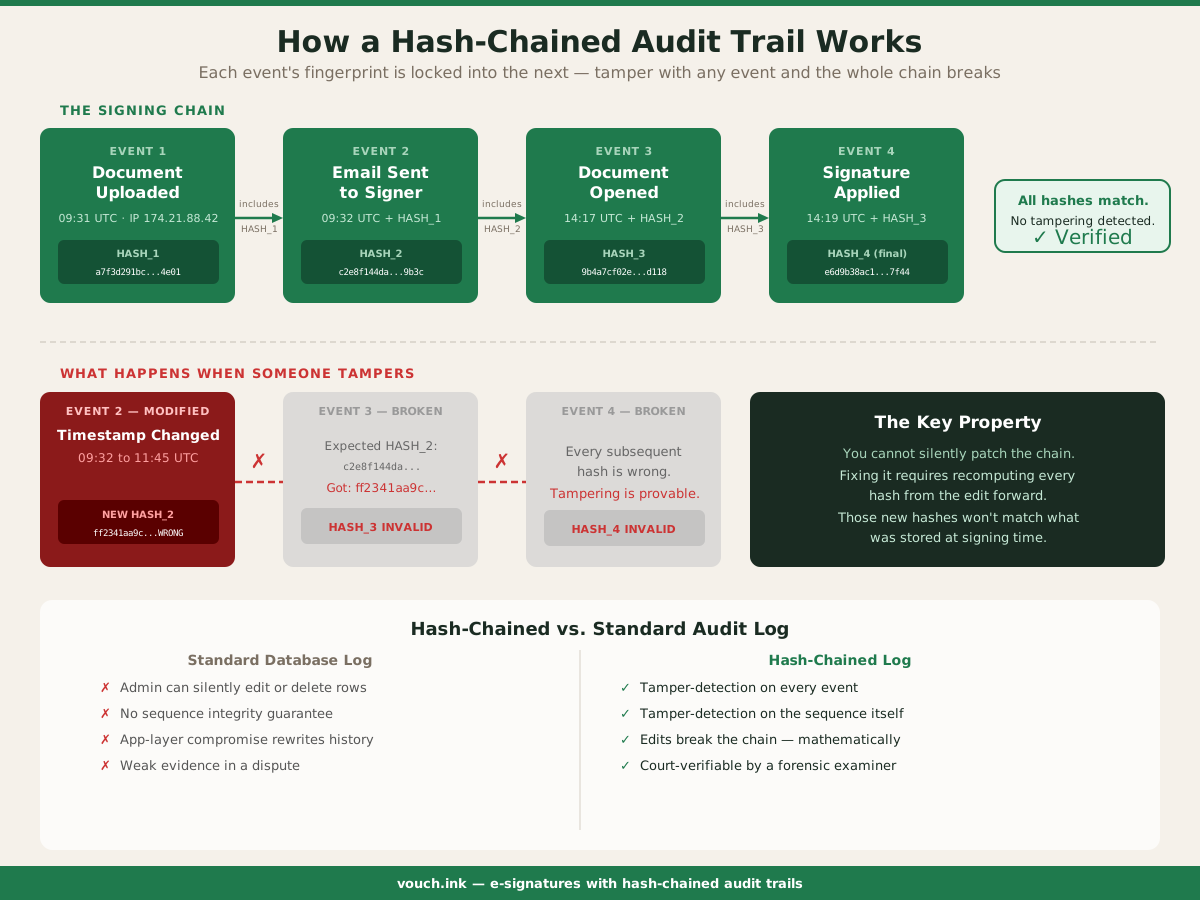
A single hash proves one event hasn't changed. Chaining proves the sequence hasn't changed — that events weren't deleted, reordered, or inserted after the fact.
Here's the mechanism:
Hash_1.Event_2_data + Hash_1 and produces Hash_2.Event_3_data + Hash_2 and produces Hash_3.Event_4_data + Hash_3 and produces Hash_4.Each hash includes the previous hash as part of its input. That means Hash_4 is mathematically dependent on everything that came before: the upload event, the email event, the open event, and the signing event — in that exact order.
If someone edits Event 2 to change the delivery timestamp, Hash_2 changes. That makes Hash_3 wrong (it was computed against the old Hash_2). Which makes Hash_4 wrong. The break propagates forward through every subsequent event and can't be hidden.
You can't silently patch a hash-chained log. Fixing the chain would require recomputing every hash from the modified event forward — and those new hashes won't match what was stored at signing time.
| Feature | Standard database log | Hash-chained audit trail |
|---|---|---|
| Records all signing events | ✓ | ✓ |
| Individual event tamper-detection | ✗ | ✓ |
| Sequence tamper-detection | ✗ | ✓ |
| Admin can silently edit rows | Yes | No — breaks chain |
| Court-verifiable integrity | Weak | Strong |
| Survives application-layer compromise | No | Yes (if stored separately) |
A standard database audit log is a table. Anyone with write access — including a compromised admin account — can edit rows. The log looks fine after the edit. There's no way to tell from the data itself whether anything was modified.
A hash-chained log makes every event a mathematical commitment. Permissions don't override the math.
A home services contractor in Raleigh sent a $6,800 scope-of-work agreement to a residential client. The client signed it digitally. Three months later, the client disputed one line item — a $1,200 HVAC inspection add-on — claiming they never agreed to it.
The contractor's e-signature platform produced a hash-chained audit trail showing:
All hashes matched. The document hadn't changed between upload and signing. The dispute was resolved in one hour, without small claims court.
If the platform used a standard database log, the client's attorney could have argued the document was modified after signing and the log edited to cover it. The hash chain made that argument non-viable — not because anyone said so, but because the math said so.
Most platforms that implement hash-chaining say so explicitly in their security or compliance documentation. Look for terms like "hash-chained audit log," "cryptographic audit trail," or "tamper-evident signing record." Generic language like "we record all signing events" tells you nothing about whether the log itself is protected.
For a deeper look at everything a complete audit trail should capture — timestamps, IP addresses, document hashes, identity verification methods — see what an audit trail actually records. For the legal standards your trail needs to meet, the ESIGN Act and UETA compliance page covers what both laws require from evidence of intent and record integrity.
NIST maintains the reference documentation on cryptographic hash standards if you want the primary source on SHA-256 and related algorithms.
Hash-chaining is the difference between a log that says "here's what happened" and one that can prove it — in court, under scrutiny, without relying on anyone's word that the records haven't been touched.
For contracts where the other party might later claim the terms were different, that distinction is exactly what you want.
Start sending contracts with a hash-chained audit trail — try vouch.ink free.
A hash chain links each event in an audit log to the one before it by including the previous event's cryptographic fingerprint in the next entry. Change any earlier event and every subsequent hash breaks, making tampering immediately detectable.
A regular audit log is a list of events stored in a database — an admin with database access can edit or delete rows. A hash-chained log makes each event mathematically dependent on all prior events, so edits leave a detectable break in the chain.
Neither law specifies the technical method — they require evidence of intent and integrity. Hash-chaining is the strongest tamper-evidence method available and the standard used by platforms that take dispute-readiness seriously.
Yes. The verification is deterministic — a forensic examiner runs the hash function against the events in sequence and checks whether the output matches the stored values. A mismatch proves tampering; a match proves integrity.
Every entry after the changed event produces a different hash than what was originally stored. The break is permanent and detectable — you can't repair the chain without regenerating all subsequent hashes, which itself constitutes evidence of tampering.