DocuSign vs. HelloSign vs. vouch.ink: Side-by-Side for Solo Operators
Choosing between DocuSign, Dropbox Sign (formerly HelloSign), and vouch.ink? Here's a plain-English breakdown of pricing, audit trails, and who each tool actually serves.
Choosing between DocuSign, Dropbox Sign (formerly HelloSign), and vouch.ink? Here's a plain-English breakdown of pricing, audit trails, and who each tool actually serves.

If you're choosing between DocuSign, Dropbox Sign (the product formerly marketed as HelloSign), and vouch.ink, the answer mostly comes down to one question: how much do you need from your audit trail? DocuSign is the enterprise default. Dropbox Sign is the approachable middle. vouch.ink is built for operators who want a full chain-of-custody record without per-seat pricing. Here's what actually separates them.
HelloSign was acquired by Dropbox in 2019. The rebrand to "Dropbox Sign" completed around 2023, so if you're searching for "HelloSign" in 2026, you're looking at the same product — just at sign.dropbox.com, with Dropbox ecosystem integration baked in.
Why does this matter for your decision? Because the Dropbox integration shapes who this tool fits best. If you already use Dropbox for file storage, the handoff between storage and e-signature is seamless. If you don't, the Dropbox branding adds nothing — it's just an e-signature tool with a different name.
Many comparison articles still use "HelloSign." For clarity: HelloSign = Dropbox Sign. Same product, same pricing tiers, different URL.
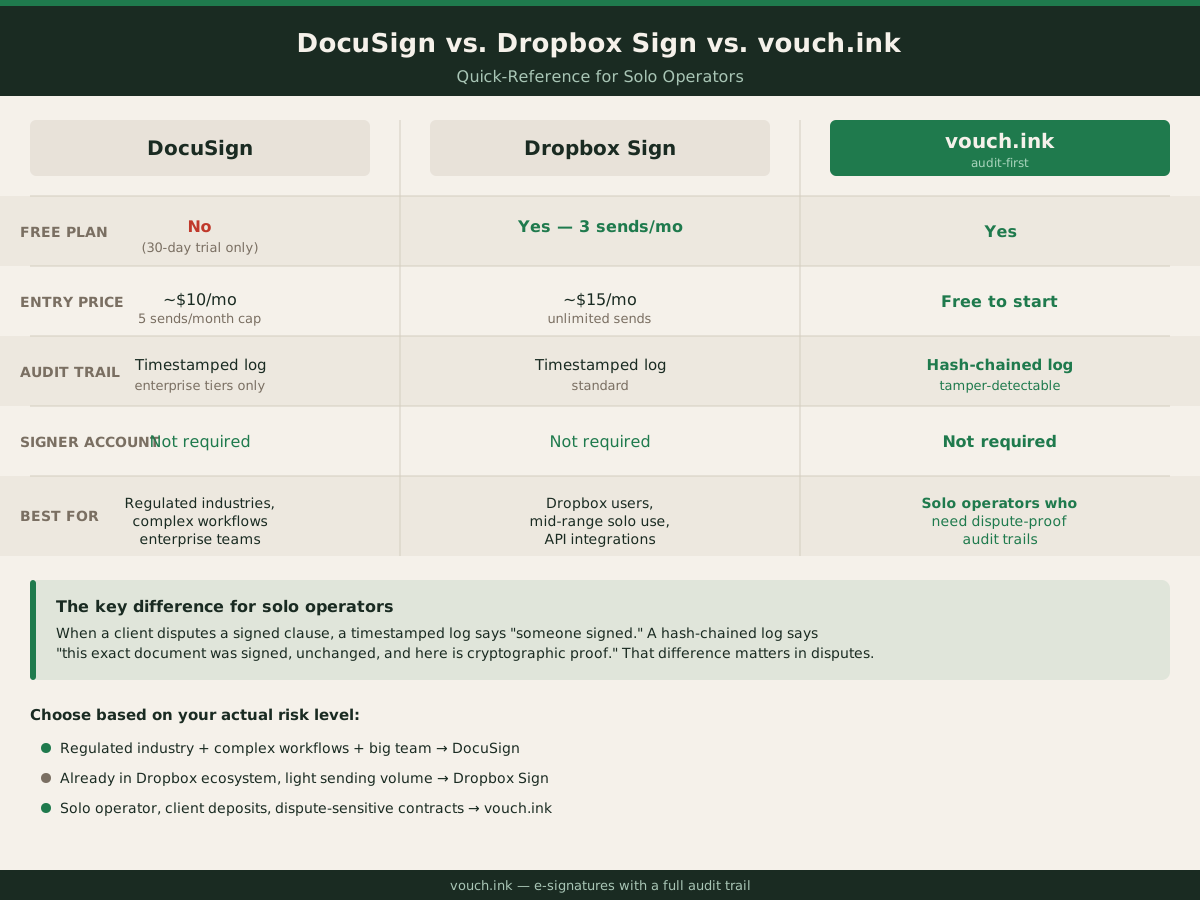
Here's how the three tools compare across the dimensions that matter most to someone sending contracts for client work, rental units, photography sessions, or freelance projects.
| DocuSign | Dropbox Sign | vouch.ink | |
|---|---|---|---|
| Free plan | No (30-day trial only) | Yes — 3 sends/month | Yes |
| Entry price | ~$10/month | ~$15/month | Free to start |
| Monthly sends (entry) | 5 (capped) | Unlimited (paid) | — |
| Audit trail type | Timestamped log | Timestamped log | Hash-chained log |
| Recipient needs account | No | No | No |
| Best for | Enterprise workflows | Mid-range / API builders | Audit-first solo operators |
A few notes. DocuSign's personal plan caps you at 5 monthly envelope sends. That sounds like enough until you hit month 5 of a busy client season and find yourself manually tracking which sends you've used. Dropbox Sign's Essentials plan removes that cap, which is the headline feature for freelancers burned by per-document pricing.
Neither charges for the recipient — your client signs for free on all three platforms. Only the sender pays.
When everything goes smoothly, all three tools feel roughly the same. The difference appears when a client says: "I never agreed to that clause."
A standard audit trail tells you: this email address signed this document at 2:14 PM from an IP address in Georgia. In most disputes, that's enough. But "in most" isn't "in all."
A hash-chained audit trail does something additional. Each recorded event cryptographically references the previous one. That chain means you can demonstrate that no event was inserted, removed, or reordered after the fact — the same principle behind tamper-evident records in other high-stakes systems. You're not just proving it was signed. You're proving this exact document, unchanged, was signed.
Here's a scenario that happens more than it should. A wedding photographer in Savannah sends a $4,200 deposit contract to a couple. After the event, the clients dispute the cancellation clause, claiming it "wasn't in the version they signed." The photographer has a timestamped record proving the document was signed — but no way to prove the document content hasn't changed since then. The dispute stretched to six weeks and a mediation session.
A hash-chained record cuts that conversation to one email. If you send contracts where disputes are plausible — deposits, cancellation clauses, scope-of-work agreements — the quality of your audit trail isn't optional.
The ESIGN Act sets the floor for what constitutes a valid electronic record, but it doesn't mandate audit trail depth. That choice belongs to the tool you pick.
For more on what audit trails actually capture, see what an audit trail actually records.
Most solo operators — photographers, contractors, coaches, landlords, tutors — share the same core needs:
For requirements 1 through 3, all three tools are essentially equivalent. Requirement 4 is where they diverge.
DocuSign satisfies it for regulated industries with complex chain-of-custody requirements. For a freelance brand designer sending client retainers, the enterprise audit tier is overkill and priced accordingly.
Dropbox Sign satisfies it for most routine use cases. If your contracts are uncomplicated and client disputes are rare, the basic log is fine.
vouch.ink is built around requirement 4 for everyday operators. The hash-chained trail isn't an add-on; it's the core product. That makes it a different fit than either of the other two — not better at everything, but specifically better at the one thing that matters when things go sideways.
For a deeper look at how vouch.ink compares to DocuSign specifically, see our DocuSign comparison page.
HelloSign was acquired by Dropbox in 2019 and rebranded to Dropbox Sign in 2023. The product works the same way. You'll find it at sign.dropbox.com.
DocuSign doesn't offer a free plan as of 2026. It offers a 30-day trial, then the cheapest paid option caps you at 5 envelope sends per month.
All three tools log who signed, when, and from what IP address. vouch.ink records a hash-chained event trail — each action cryptographically references the previous one, making retroactive alterations detectable.
Dropbox Sign's free plan covers 3 sends a month at no cost. For more volume or stronger dispute documentation, compare what each platform actually records — that's what matters when a client disputes a term six months later.
No. On all three platforms, recipients receive an email link and sign in the browser. Only the sender needs an account.
Not sure which fits your workflow? vouch.ink is free to start — your first contract could be signed in under three minutes.
HelloSign was acquired by Dropbox in 2019 and rebranded to Dropbox Sign in 2023. The product still works the same way. Many users still search for it by the HelloSign name.
DocuSign doesn't offer a free plan as of 2026. It provides a 30-day trial, after which the cheapest option is a personal plan that caps you at 5 envelope sends per month.
All three tools log who signed, when, and from what IP address. vouch.ink records a hash-chained event trail where each action is cryptographically linked to the previous one, making retroactive alterations detectable.
For light use, Dropbox Sign's free plan covers 3 sends a month. For higher volume with stronger audit documentation, compare what each platform records when a client later disputes a contract term.
On all three platforms, recipients don't need an account. They receive an email link, sign in the browser, and get a copy. Only the sender needs an account.