← All postsMay 27, 2026 · 6 min read
DocuSign vs. SignNow vs. vouch.ink: Which Is Right for a Team of 1–10?
DocuSign Standard is ~$1,500/yr for a 5-person team. SignNow Business is $96/yr flat (unlimited users). vouch.ink Business is $72/yr with 3 users included and hash-chained audit trails on every plan.
DocuSign costs $25/user/month on its Standard plan — about $1,500/year for a 5-person team. SignNow's Business tier is $8/month flat for unlimited users — $96/year for the same team. vouch.ink Business is $6/month billed annually ($8 monthly) with three users included and $4 per extra user — and, unlike SignNow, no cap on invites. The pricing gap is real, but price alone won't tell you which platform holds up when a $6,500 client contract gets disputed six months from now.
Here's an honest look at what these tools actually do, where they diverge, and what a small team should weigh before committing.
Price and Document Limits, Side by Side
The number that catches most small teams off guard isn't the monthly fee—it's the document limit buried in the plan details.
DocuSign's Personal plan starts around $15/month but caps you at 5 sends per month (60 per year). That sounds manageable until three clients need something in the same week: a retainer, a change order, and an NDA. Hit send on document 61 and you get a prompt to upgrade. DocuSign's Standard plan at roughly $25/user/month raises the ceiling significantly—but now you're paying per seat. Five people on Standard costs about $125/month, or $1,500 per year.
SignNow's entry Business plan runs $8/month flat (billed annually) and includes unlimited users on the same subscription, with a 100-signature-invite-per-user annual quota. For a 5-person team that's $96/year total — a fraction of what DocuSign Standard charges for the same headcount. SignNow's flat-rate model means adding a teammate doesn't bump the bill.
vouch.ink's Business plan is $6/month billed annually ($8 monthly, $72/year) with three users included and $4 per extra user, with unlimited documents, 3 reusable templates, and the hash-chained audit trail included on every plan — not gated behind a higher tier.
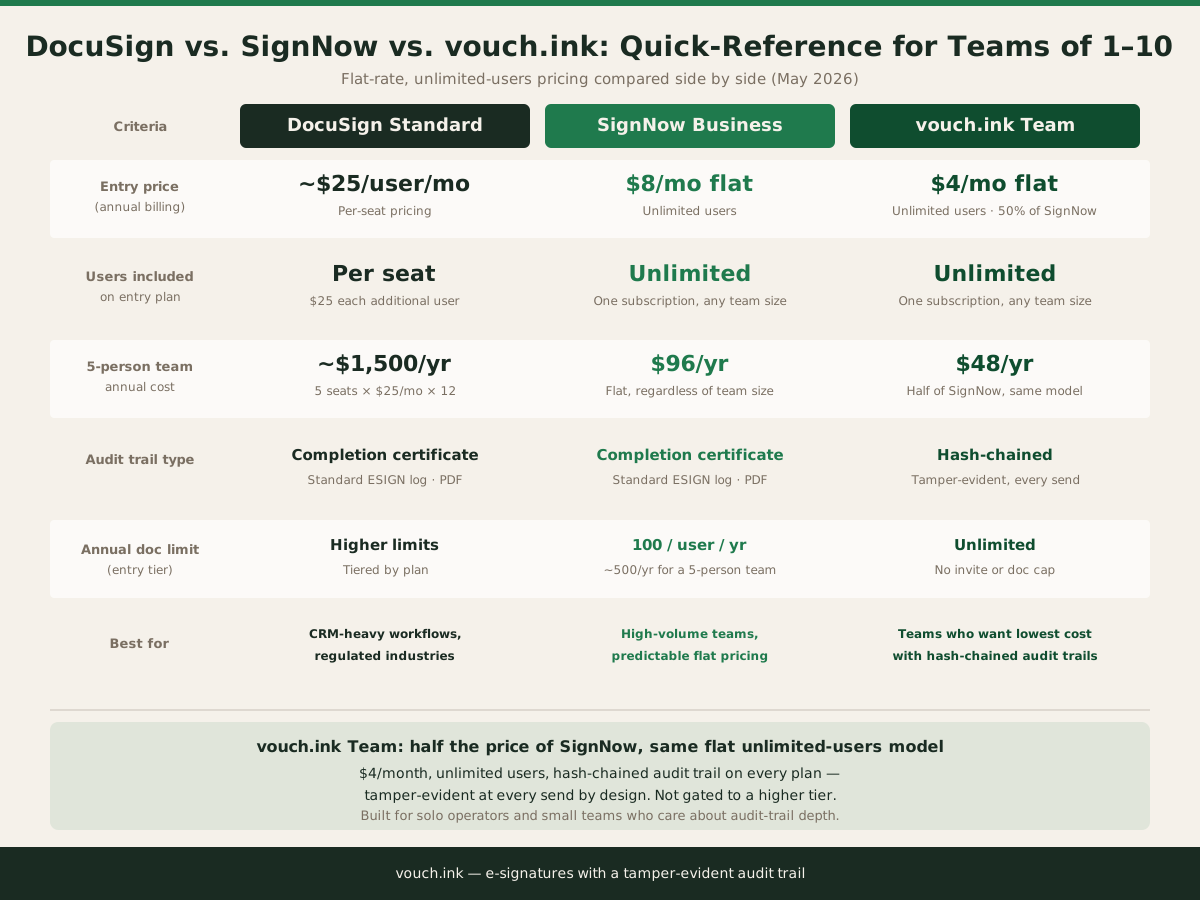
|
DocuSign Personal |
DocuSign Standard |
SignNow Business |
vouch.ink Team |
| Entry price (annual billing) |
$10/mo |
$25/user/mo |
$8/mo flat |
$6/mo, 3 users included |
| Entry price (monthly billing) |
$10/mo |
$25/user/mo |
$20/mo flat |
$8/mo |
| Users included |
1 (solo) |
Per seat |
Unlimited |
Unlimited |
| Annual doc limit |
60/yr |
Higher limits |
100/user/yr |
Unlimited |
| Annual cost, 5-person team |
N/A |
~$1,500/yr |
$96/yr |
$168/yr (3 seats included + 2 × $4/mo) |
| Audit trail |
Completion cert |
Completion cert |
Completion cert |
Hash-chained, tamper-evident |
Pricing from publicly available plan pages as of May 2026. Verify with each provider before purchasing.
The Integration Question
One area where DocuSign holds a clear edge is its integration library. Native connectors with Salesforce, HubSpot, Google Workspace, Dropbox, and Microsoft 365 let contracts flow directly from your CRM into a signing workflow without exporting PDFs manually. For teams whose revenue tracking lives inside a CRM, that automation can save meaningful time every week.
SignNow supports the common integrations—Salesforce, HubSpot, Zapier, Microsoft Teams—but its connector library is narrower. For most small teams sending contracts by email or shared link, this gap doesn't affect day-to-day work. If your workflow is CRM-driven, it might tip the decision.
If you don't rely on a CRM, neither platform's integration depth changes your workflow much. A simple "upload PDF → add signers → send link" flow works the same on both. Most independent contractors and service businesses in the 1–10 employee range don't need the integration layer that justifies DocuSign's per-seat cost.
Audit Trail Depth—The Part Most Comparisons Skip
Both DocuSign and SignNow generate a Completion Certificate—a PDF recording who signed, when, and from what IP address. This is the baseline ESIGN-compliant log required under the Electronic Signatures in Global and National Commerce Act. For the vast majority of business contracts, a standard completion certificate is sufficient evidence if a dispute arises.
What differs between platforms is tamper evidence. A PDF completion certificate is a separate document that exists outside the signing chain—it could, in theory, be altered without the alteration being immediately detectable. A hash-chained audit trail links each event cryptographically to the next. Modify any record and the chain breaks visibly. It's the same principle used in financial ledgers and legal record-keeping systems.
For a freelancer sending 8 contracts a year, a standard certificate works fine. For a landlord managing 47 units in Towson who signs lease renewals every spring, the depth of that record is real protection when a tenant later disputes the terms of what they signed. The question isn't whether DocuSign or SignNow offers "enough" of an audit trail—it's whether you've thought about what enough means for your specific contracts.
vouch.ink builds around a hash-chained audit trail by default—tamper-evident at every send, not as an optional add-on.
Which Tool Fits a Team of 1–10?
The honest answer depends on three things: how many documents you send, which integrations matter, and what a disputed signature would cost you.
DocuSign makes sense if:
- Your clients recognize the DocuSign brand and sometimes expect to see it on the email
- You use Salesforce or HubSpot with native integration requirements that save meaningful workflow time
- You're in healthcare, finance, or government where specific DocuSign compliance certifications are contractually required by your clients or regulators
SignNow makes sense if:
- You want $96/year flat for unlimited users on a single subscription (Business tier, annual billing)
- Your team's combined document volume fits inside the 100-invite-per-user annual quota
- You want a clean, fast signing experience without enterprise-scale overhead you won't use
vouch.ink makes sense if:
- You want a hash-chained, tamper-evident audit trail included on every plan — including the free tier
- You want the cheapest full plan on the market: $6/month billed annually ($8 monthly), three users included — unlimited documents, not 100 invites a year.
- You're a solo operator or small team who values audit-trail depth and predictable, per-seat-free billing
A Real-World Scenario
A wedding photographer in Portland sends 15 contracts a year—retainer agreements averaging $4,200 each. Volume is too low to justify enterprise per-seat overhead. But at $4,200 per booking, one disputed contract is a quarter's revenue at risk.
Her question wasn't which platform had the most integrations. It was which one gives her the clearest, most defensible record if a client later says the deposit terms weren't what they agreed to. She moved to vouch.ink because the audit trail is built into every send—not a tier upgrade, not an add-on. Her document count stayed the same. Her confidence in the paperwork changed.
Four Questions to Ask Before You Choose
- How many documents per month? If consistently under 5, DocuSign's Personal plan may work. Over 20, check overage terms carefully—they add up faster than the monthly fee suggests.
- Which integrations matter to your workflow? If you live in Salesforce or HubSpot, DocuSign's native connector saves real time. If you mostly email PDFs, this becomes irrelevant.
- What would a disputed signature cost you? The higher that number, the more audit trail depth is worth understanding—and the more worthwhile it is to compare what each platform actually records.
- Do your clients care which platform you use? In regulated industries, they sometimes do. For most independent contractors and small service businesses, any ESIGN-compliant platform meets client expectations.
The Bottom Line
For most teams of 1–10, SignNow wins on raw price against DocuSign — $96/year flat for unlimited users vs. ~$1,500/year per-seat. DocuSign wins on integration depth and brand recognition in enterprise contexts. vouch.ink Business is $72/year with three users included (Personal is $45/year for one person) and is the only option of the three with a hash-chained, tamper-evident audit trail included on every plan — not gated to a higher tier.
If audit trail depth matters more to you than document volume—or you want a workflow built for the way small teams actually operate—it's worth reviewing your options before defaulting to either. See our pricing page for a direct comparison of what vouch.ink includes at each tier.
Your contracts deserve a record that holds up. Start free on vouch.ink and send your first document in under two minutes.