A design job has three moments where a signature changes what happens next. The client signs off on the proposal and you start work. The two of you sign the contract and agree who owns the files when it's over. The client approves the final invoice, or the deposit invoice, and money moves. All three can happen on a screen. The one people rush through, the ownership clause, is the one that most needs a real signature.
What federal law says about signing on a screen
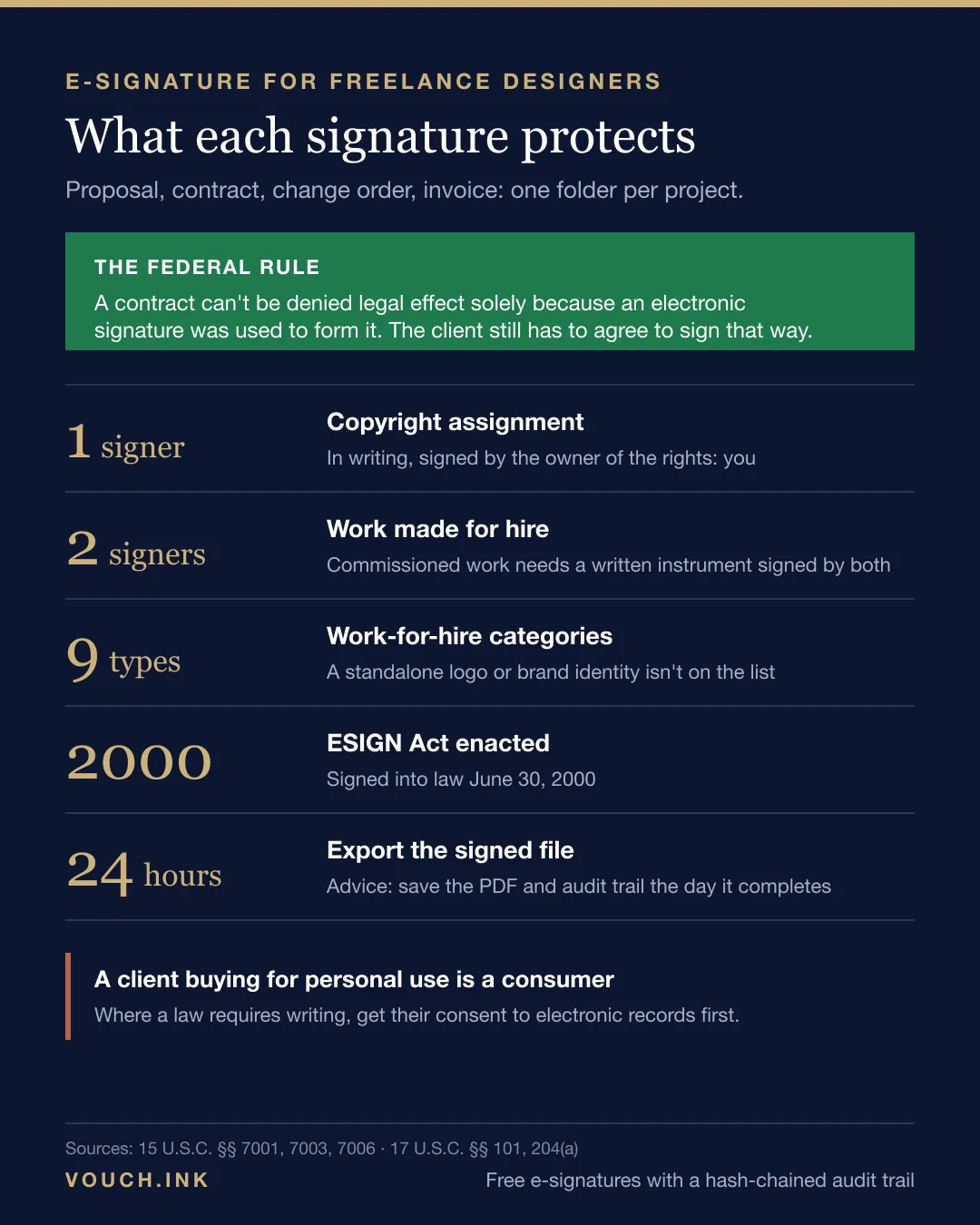
The ESIGN Act, signed into law on June 30, 2000 and codified at 15 U.S.C. § 7001 and the sections after it, is the federal rule for electronic signatures in commerce. For a transaction in or affecting interstate commerce, a signature, contract or other record may not be denied legal effect, validity or enforceability solely because it is in electronic form. A contract can't be denied effect solely because an electronic signature or record was used to form it.
The definition in § 7006 is broad. An electronic signature is an electronic sound, symbol or process, attached to or logically associated with a record, and executed or adopted by a person with the intent to sign it. A typed name, a drawn signature on a phone or a click on a clearly labeled button can all qualify. What makes it a signature is the intent, so your process should make that intent obvious: the client sees the whole document, then takes a deliberate action to sign it.
There's one thing the law won't do for you. It doesn't require anyone to agree to use or accept electronic signatures. Plenty of clients are happy to sign on a phone, but if one insists on a printed copy, that's their call, and you should have a PDF ready to print.
Put the ownership clause in writing first
A logo, a brand system or a website design is creative work, and copyright in it starts with you. What the client walks away owning depends on what you both sign.
Federal copyright law is strict here. Under 17 U.S.C. § 204(a), a transfer of copyright ownership, other than by operation of law, is not valid unless an instrument of conveyance, or a note or memorandum of the transfer, is in writing and signed by the owner of the rights conveyed. As the designer, you're that owner. An email that says "the files are yours" is a weak foundation for a client who later wants to register a trademark or sell the company.
Many clients ask for "work made for hire" language instead. For a freelancer, that only works in narrow cases. Under the definition in 17 U.S.C. § 101, a specially ordered or commissioned work counts as made for hire only if it falls into one of the listed types (a contribution to a collective work, part of a motion picture or other audiovisual work, a translation, a supplementary work, a compilation, an instructional text, a test, answer material for a test, or an atlas) and the parties expressly agree in a written instrument signed by them. A supplementary work includes pictorial illustrations prepared for publication alongside another author's work. A standalone logo or brand identity doesn't appear on that list.
That's why most freelance design contracts use an assignment clause, sometimes paired with work made for hire language as a backup. Have a lawyer write the clause once, then reuse it. What the signing process adds is proof: who signed, when, and which version of the document they saw.
A signing routine from proposal to final file
A routine you repeat on every project protects you better than one heroic contract. Here's one that fits a solo studio.
The proposal. Send the scope, timeline, number of revision rounds and price as one document. Ask for a signature on the last page. A signed proposal settles the "I thought three logo concepts were included" conversation before it starts.
The contract. Keep it separate from the proposal so it can be reused. It should name the deliverables by reference to the signed proposal, set the payment schedule, and include the ownership clause. State when ownership moves: on final payment is the common choice, and it gives the client a clear reason to pay the last invoice on time.
Change requests. When a client asks for a new page, a second brand mark or a print run you didn't price, write a one-page change order with the new scope and cost, and get it signed before you open the file. On a phone this takes the client a minute. Without it, extra work tends to become free work.
Final delivery. Send the files, the final invoice, and if ownership transfers on payment, a short signed confirmation that the transfer is complete. That last page is the one a client's lawyer will ask for years from now.
Try it on five docs.
Free, no credit card. The full audit trail on every plan, including this one.
Invoices and deposit approvals
Invoices rarely need a signature to be valid. You can still use one where it helps. A signed deposit invoice ties the first payment to a specific proposal, which helps when a project stops halfway. A signed approval on the final invoice confirms the client accepted the work.
Keep invoices in the same project folder as the signed proposal and contract. When a client disputes a charge months later, you'll want the proposal that set the price, the change order that raised it and the invoice that billed it, all with dates.
When the client is a person, not a business
Most design clients are companies, but some are individuals: a couple ordering wedding invitations, someone commissioning a portrait. Federal law treats a consumer as an individual who obtains products or services used primarily for personal, family or household purposes.
That distinction comes up in one situation, under § 7001(c). If a law requires that certain information be given to a consumer in writing, an electronic version satisfies that rule only if the consumer has affirmatively consented and was first told about things like the right to get the record on paper and how to withdraw consent. For a typical design contract with a business client, that consent process doesn't apply. For a personal commission, have the client confirm they agree to receive and sign documents electronically.
Section 7003 puts a short list of documents outside the ESIGN rule altogether, including wills, family law matters such as adoption and divorce, and official court documents. A design studio almost never touches them.
Keep the signed file where you can reach it
Signing is half the job. The other half is being able to prove it later. Under § 7001(d), when a law requires a record to be retained, an electronic copy meets that rule if it accurately reflects the information in the original and stays accessible, in a form that can be accurately reproduced, for the period the law requires.
In practice, that means exporting the signed PDF and its audit trail the day the last signature lands, and saving both in storage you control. Name files the same way every time: client, project, document, date. When a client asks in two years who owns the logo, you'll answer with a file, not a memory.
Questions people ask
Is an e-signed design contract as valid as one signed in ink? Under the federal ESIGN Act, enacted in 2000, a contract may not be denied legal effect solely because an electronic signature was used to form it. The client still has to agree to sign electronically.
Who has to sign a work made for hire agreement with a freelancer? Both parties. For a commissioned work, federal copyright law requires a written instrument signed by both sides, and only 9 kinds of work qualify.
Does a copyright assignment need the designer's signature? Yes. A transfer of copyright ownership is valid only if it is in writing and signed by the owner of the rights conveyed, which is 1 signature at minimum: the designer's.
How soon should I save a copy of the signed contract? The same day it completes, ideally within 24 hours of the last signature. Save the signed PDF and its audit trail together in storage you control.
You can try this on your own documents at https://vouch.ink/. Every plan, including free, includes the full audit trail. Compare plans at https://vouch.ink/pricing.
Try it on five docs.
Free, no credit card. The full audit trail on every plan, including this one.